During my seven nights in Aix-en-Provence, a bustling little town in the south of France surrounded by mountains, two were spent in the Grand Theatre of Provence, and they were two well-spent nights indeed.
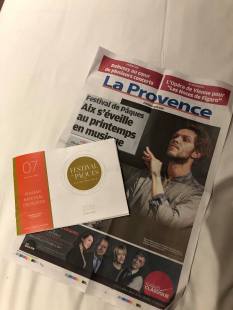
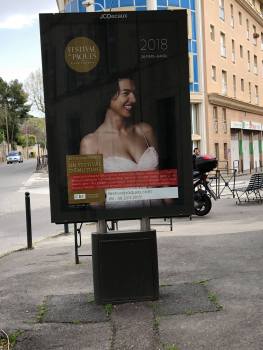
The Festival de Pâques is a festival of classical music held every Easter in Aix-en-Provence, the former capital of the Provence region, gathering some of the biggest names together in this small town for two weeks of great music. This year, the sixth year it is held, proves to be no different. Mixing rising stars such as the young pianists Lucas Debargue (my idol) and Khatia Buniatishvili with legendary masters Emmanuel Pahud, Gautier Capuçon, Martha Argerich and Daniel Barenboim (to name but a few!), the concerts are sure to keep little children from falling asleep, send home youngsters inspired and keening to practise, and local oldies murmuring with satisfaction as they filter out of the hall.
I would like to share my experience of attending the two concerts in the festival. Due to my typical lack of organization and planning in advance, I was only able to secure tickets to two performances. The first one was on the 6th of April, where the Bremen Chamber Philharmonic, led by esteemed Paavo Järvi, performed an all-Brahms programme of his Violin Concerto (soloist Veronika Eberle) and his First Symphony. The second one was the night after, presenting the Russian National Orchestra, led by Mikhail Pletnev, playing Karłowicz’s Serenade for strings and Tchaikovsky’s Third Symphony, sandwiching a performance of Ravel’s Piano Concerto starring Lucas Debargue.
Now, THIS IS NOT A CONCERT REVIEW. I am merely trying to put my feelings into words. Don’t expect an amateur concert-goer like me to find fault in world-class performers that I feel more than privileged to be able to attend the concert of.
Firstly, the vibe. Considering pretty much the whole concert hall was filled by senior citizens or men in suits, the atmosphere was surprisingly bubbly. The soloists of both concerts ended up playing two encores respectively, and even the guest orchestras were compelled to play encores themselves. What really put a smile on my face was the way the audience, as one, started clapping synchronically to get their encore. It was really funny the way the applause slowly but steadily merged into synchronized clapping. It was like looking at an optical illusion with multiple images. Once you start seeing the second image, you can’t unsee it. That was how the synchronized clapping felt, and that really made me feel like the audience had a mind of its own, and I don’t think I’ve experienced something like that before. Not in a classical concert. Full of oldies. Also, not only were they welcoming to foreign orchestras, they were immensely proud of their homegrown pianist, Lucas Debargue. You could tell they treated him differently. It felt different. During the performance of the Ravel piano concerto, people in the third ring, where the view was quite obscured, were standing up to watch the French pianist play, and some even went as far as sitting on the steps. And when he finished, the bravos were definitely much more passionate and full of pride. All in all, the atmosphere was fantastic.
Luckily for me, I was able to witness foreign orchestras bringing their own country’s music with them to this small town. The Bremen Chamber Philharmonic played Brahms, and the Russian National Orchestra played Tchaikovsky. In other words, the orchestras were in their element, and by God it felt great listening, experiencing. I am definitely not one to know what the authentic Brahmsian sound would be, or the Tchaikovsky-esque feel. But what I know is that both orchestras were very distinct in their sound, and very very convincing in their performance. Bremen Phil, with its compact size, managed to convey such amazing energy with the unspoken bond between the musicians as well as the conductor. The swells, the pauses, the slowing-downs, they were just so well-coordinated, it made the hair on my neck rise. The excitement I felt in the last movement of Brahms–God it was amazing. Veronika Eberle also poured her heart out in the violin concerto, especially the cadenza. Her violin was sonorous, her sound so powerful I was surprised neither bow nor instrument snapped in half before the finale. It was the energy that the Bremen Chamber Philharmonic created that made its sound so authentic and its performance riveting. You know you really are concentrating when even the voice inside your head stops speaking to listen. That feeling of presence is really unique, and I felt that.
The Russian National Orchestra brought a very different vibe. For one, Mikhail Pletnev was way less dynamic than Järvi, only beating the pulse and cuing instruments. Yet the orchestra was able to play with the grandeur and pomposity required by a Tchaikovsky Symphony as if Bernstein were squeezing every ounce of sound out of them. Their sound was distinct from Bremen Phil’s, and it’s not only because of the difference in size (they had like 8 double basses while Bremen had 4, and that ratio accounts for the ratio of the entire orchestra sizes) but also of the way sound is created. Their violins have a mournful swell to it, and move as if they are one in a lyrical way. But when it came to the finale of the Symphony, the blast from the brass section and the timpani bangs is overwhelming. I have never heard Tchaikovsky’s Third Symphony in my life, but they still managed to grab my attention, as if telling me that no one should look down on their great composer’s less famous work just because it is overshadowed by the Pathetique or Swan Lake or whatnot. Now I’ve got the recording of Tchaikovsky’s complete Symphonies recorded by the Russian National Orchestra with Pletnev downloaded on my phone. How about that.
 I want to mention another aspect of the Bremen Chamber Phil that I was really impressed with. When the orchestra came in, they bowed together. Like the whole orchestra. Same goes for when they leave the stage. They bow together. I’ve never seen any orchestra do it. And right before their final bow, they exchange hugs with each other, congratulating themselves on stage. I was really warmed by that, because it made the performance experience all the more intimate, and I tell you, that intimacy really showed forth in their performance. I think nothing beats sharing an electrifying moment during a performance with fellow musicians on stage. It’s better than getting a pump in the gym. It’s like a hundred people getting a pump in the gym, at the same time. Comraderie, satisfaction, wonder, all the best feelings can be experienced. No homo.
Yesterday I read an article about the orchestra Spira Mirabilis on Facebook, the ‘radically democratic’ orchestra that plays without a conductor. I wonder what sort of intimacy and bond the players share.
My experience at the Festival de Pâques was amazing, and I definitely want to come back one summer to witness their even more monumental Summer Festivals, which do not only occur in Aix, but also all over Southern France, in Avignon, Marseille and all those wonderful places. But until then, Aix-en-Provence, you have been great.
And for those who called me a nerd: Yeah, I am one.

 Literally Left-handed
Leave a comment