
After my first entry on the Leeds Piano Competition, an avid reader of my blog (my dad actually) suggested to me that I should take into account the quality of sound I get from the laptop I use, which is why from now on I vow to refrain from listening to the performances on the Lenovo laptop I use at work. I will only use my Macbook to listen to them. It definitely provides better sound quality. On to my next entry then:
GROUP 2
Florian Caroubi (France)
Yuchong Wu (China)
Jean-Selim Abdelmoula (Switzerland)
Evelyne Berezovsky (United Kingdom)
Florian Caroubi, 28
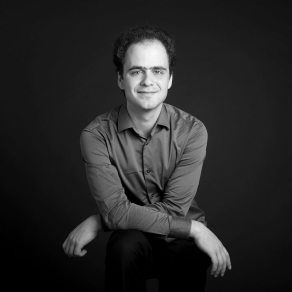
I must say, when I first saw Florian Caroubi’s programme for the First Round, I was very excited. A Frenchman playing French repertoire is not to be missed, but then again, they always include French works in their programme…I’m not sure why I’m excited. I guess it’s because I love watching the French play their own stuff.
For his First Round, Florian played Haydn’s Andante and Variations in F Minor, Hob. XVII: 6 and Debussy’s Images: Book II. I’ve grown to appreciate Haydn’s Andante and Variations. Although I’ve always been an “Allegro-over-Andante” person, the steady pulse of the theme in the Haydn has really grown on me and I feel like underneath it lies a sense of excitement. I know this sounds weird, but Florian’s playing really made me nerves tingle with excitement. I’m sure he knows that feeling too. His perfect rhythm, the clear and crisp touch made it all the more apparent that he knows what he is doing. Haydn keeps his surprising character even in this seemingly straightforward piece. Florian makes everything before 7:15 sound like a build-up; he certainly knows how to keep his audience on their toes. This is a performance well done, but if I want to compare this performance to a steak, then it is medium rare.
But I shouldn’t compare Florian’s performance of the Haydn variations to steak. It is merely a starter which gave the audience a taste of what Florian can deliver as a performer. His Debussy was the essence of his First Round performance. As he plays the opening bars of Cloches a travers les feuilles (Bells through the leaves), his playing transforms him from a courtly gentleman to a monk who meditates in stillness while his surroundings flow past him like water. He transported the audience into a surreal, dream-like state, and made us fall in love with Debussy’s music, even through our laptops. Everything was subtly passionate; it was wonderful. In the last piece Poisson d’or (Golden fish) Florian showed me a tapestry of voices from different layers, weaving them seamlessly together. I wouldn’t even call the way he handled all the semiquavers technical brilliance; he simply flowed with the music, his fingers dipping here and there, wherever the sound demanded.
I felt a subtle exhilaration after the performance, and I can’t wait to hear more of Florian Caroubi. He will be playing Liszt’s Sposalizio in the Second Round, which I have never heard of, and–oh my god!–Schumann’s Carnaval, one of the pieces I’ve been looping lately. Now I really can’t wait.
Listen to Florian’s First Round performance here: https://leedspiano2018.medici.tv/replay/first-round-with-florian-caroubi-/
Yuchong Wu, 22
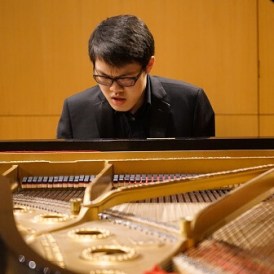
At around 28 minutes, Yuchong Wu’s First Round performance tops it as the longest performance I’ve heard so far. Although it isn’t the most interesting performance I’ve heard so far, it was nevertheless very decent. For his first round, Yuchong presented the fifth French Suite of Bach, Chopin’s Third Scherzo and Gounod’s Waltz from “Faust”, arranged by Liszt.
Yuchong played the Bach perfectly, and I liked how he played it in a simple way with a clear sound; Bach played simple brings forth its beauty. He seemed to enjoy it, humming the melody (I could see his mouth move) as he played, and that was enough to keep the music interesting to listen to. I especially liked the Gigue, which he played dexterously whilst never forgetting to lend each voice its significance.
Switching to the more tumultuous Chopin after Bach was no problem for him. I thought the Chopin was well-played but I don’t have much to comment about it, except that I liked the hesitant mood he conveyed somewhere around 17:00, and I liked the way he did rubato in the fast and agitated coda.
I think Yuchong added the Gounod-Liszt Waltz into his programme merely to show off his technique. Maybe it’s his wow factor. I didn’t find much of the piece interesting, but I have to say, the ending was pulled off with spectacular brilliance. I wish he was more exhilarated himself.
Listen to Yuchong’s First Round performance here: https://leedspiano2018.medici.tv/replay/first-round-with-yuchong-wu/
Jean-Selim Abdelmoula, 27
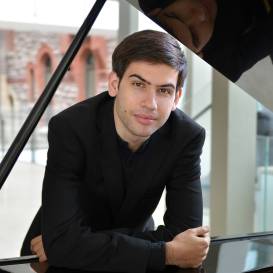
Before I begin to review Jean-Selim Abdelmoula’s performance, I must note that he looks nothing like his profile picture on the competition website. In fact, I think he looks better from the replay! This seems to happen a lot with classical musicians though, I wonder why…maybe they’d like to preserve their youth in their public photos, or that they simply don’t care about their looks unless people do their make-up for them…
From the way he sits, the way he dresses, the haircut he has and the glasses he chooses to wear, you can tell Jean-Selim Abdelmoula is a humble person. And it shows through in his humble playing. But when I say that he plays with humility I mean he treats each piece with great respect, whether it be a five-minute Scarlatti or a twenty-minute Beethoven, and I admire this respect a lot.
For his first round, Jean-Selim presented Scarlatti’s Sonata in F Minor, K. 481 and Beethoven’s 31st Piano Sonata in A Flat Major, op. 110. Not only are they contrasting in period–one being from the baroque and the other from the late Classical pushing onto the Romantic period–they are also of contrasting length; the Scarlatti is one of the earliest examples of the sonata form, whereas the Beethoven challenges the form’s conventions and extends it into an epic creation. Yet Jean-Selim places equal weight on both pieces; the way his face contorts as he relishes Scarlatti is similar to the way he enjoys the Beethoven. Whether it be a piece from the Romantic or Baroque period, his playing shows that he doesn’t believe one should deserve less emotional attention than the other.
What really captured me in his performance was that for Jean-Selim, everything in the music was important; everything had a reason; every note and rest deserved attention. This was why I felt that the Scarlatti was just as significant in the programme as the Beethoven.
Jean-Selim’s performance was quite flawless, but I never really noticed how virtuosic he was because he never made a point of showing it. He simply flowed seamlessly from minims to semiquavers as the music required. It was only at points such as the second movement of the Beethoven that I noticed how fast his fingers moved. From the way his jowls shook when he played, he was definitely very emotionally involved with the music, yet he was never rushed in his playing, and I think there’s something very attractive, encapsulating about it, something similar to the way girls find quietly intelligent boys attractive.
What unique and attractive interpretations can arise when one finds and attaches a value that is personal to oneself in a musical work! I look forward to hearing Jean-Selim’s interpretation of Janacek and Schubert in the second round.
Listen to Jean-Selim’s First Round performance here: https://leedspiano2018.medici.tv/replay/first-round-with-jean-s%C3%A9lim-abdelmoula/
Evelyne Berezovsky, 27
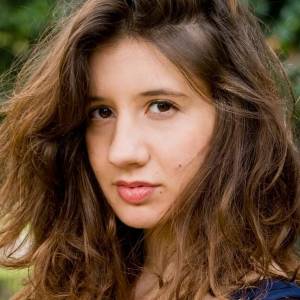
After seeing Jean-Selim play in his all-black attire and bookish glasses, Evelyne Berezovsky was a great contrast. In the world of classical music, you’re pretty much considered edgy if you’re not wearing either an all-black dress or a dress of one colour only. And so, Evelyne, with her short-sleeved dress that was black from the waist down and white with dots from the waist up, together with a beaded bracelet on her left wrist, was basically bohemian.
If the Nike training app had a finger workout, Evelyne’s First Round programme would definitely be high up in the “Advanced” category. Opening with Scarlatti’s K212 A Major Sonata, the semiquavers became double notes and octaves as Evelyne continued with Liszt’s notoriously difficult Paganini Etude No. 6 in A Minor, which then morphed into the monster of an etude that is Scriabin’s op. 42 no. 5 in C Sharp Minor. Evelyne left the longest and most passionate for the last: Scriabin’s Fantasie in B Minor, op. 28.
In contrast to Jean-Selim, who also opened with a Scarlatti, Evelyne seemed to play hers with indifference. That doesn’t mean her playing didn’t glitter, because it certainly did. Her face gave away nothing, as if she was letting the music speak for itself. This, I feel, shows a great sense of the self-assurance of her own virtuosity, an inner confidence that allows her to let her intuition flow through her fingers onto the keyboard. Impressive and mesmerizing in a very unique way.
Another thing that I thought separated her from other people who chose to include technical showpieces into their programme was that she didn’t care about showing off. Despite all the semiquavers in the upper register in the Paganini etude, Evelyne was constantly bringing out the theme or the bass, while showing the semiquavers for what they are: flamboyant decorations. This is also true for the Scriabin etude. Her strong bass octaves were so satisfying because they really increased the emotional intensity to another level for me. It’s exactly why I love this particular Scriabin etude: it’s virtuosic, but its virtuosity is used to generate the passion.
Evelyne’s performance is the first time I’ve heard Scriabin’s Fantasie. For me, one thing about Scriabin is that it’s very easy to lose track of the melody and become confused by the mass of notes and swells and all that “avant-garde”-ness. But Evelyne paid close attention to the melodic lines even amidst the jumble of notes and gave the whole thing meaning and coherence that is so crucial to the build-up to 17:26. And oh man, when you get to that B major bit (which is 17:26) it is soooo satisfying! Please go and have a listen and I’m sure you’ll be impressed.
Evelyne will be playing Chopin’s Ballade No. 4 (my fave!) and Rachmaninoff’s second sonata (glorious!) and another piece by Messiaen (something about Jesus) and I can’t wait!
Listen to Evelyne’s First Round performance here: https://leedspiano2018.medici.tv/replay/first-round-with-evelyne-berezovsky/
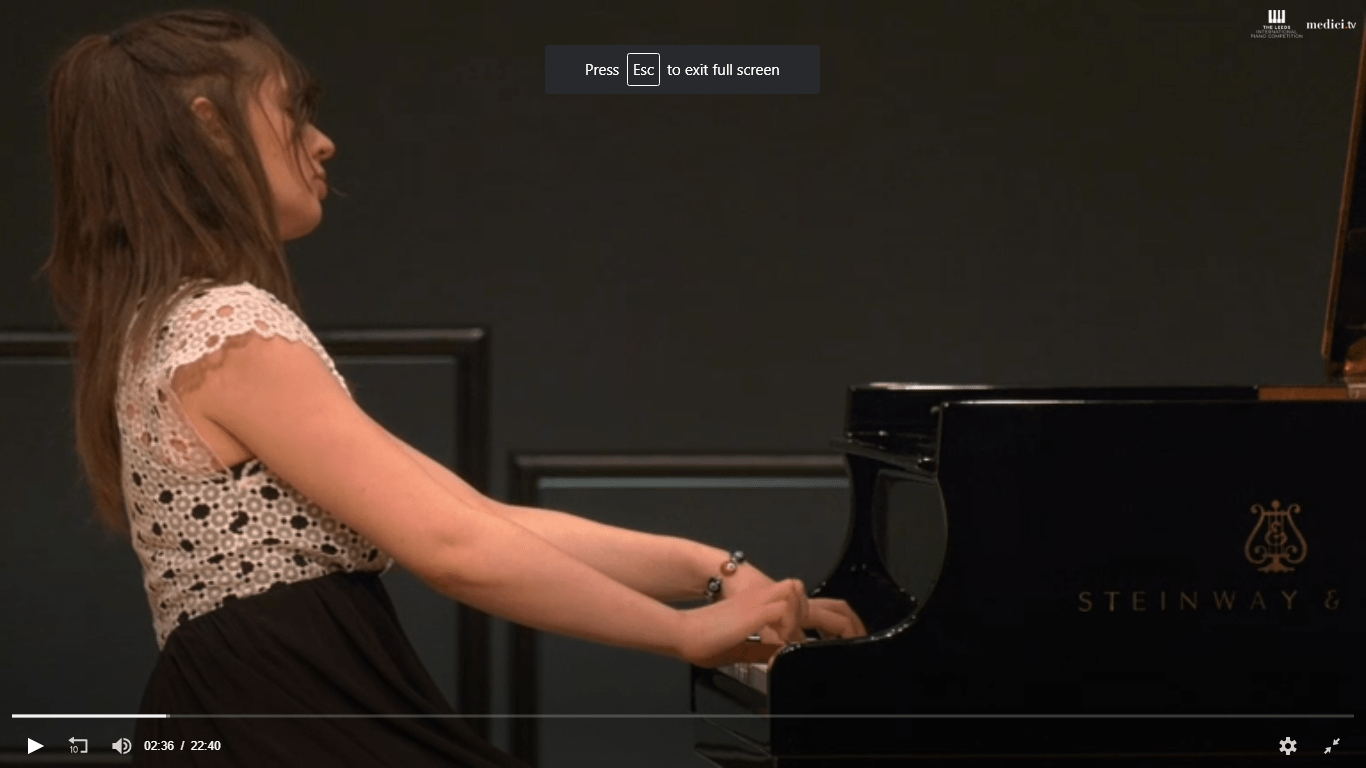
Photo source: https://www.leedspiano.com/ and https://leedspiano2018.medici.tv/replay/
 Literally Left-handed
Leave a comment