
GROUP 3
Anna Geniushene (Russia)
Salih Can Gevrek (Turkey)
Yilei Hao (China)
Mario Häring (Germany)
Anna Geniushene, 27
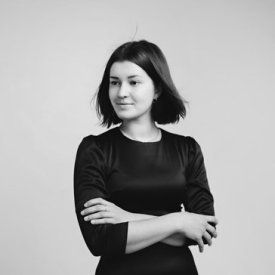
Your profile picture doesn’t look bad, why do you have to dress like a grandmother? Sorry, that was my first thought when I saw Anna’s concert dress. For her first round, Anna Geniushene presented Clementi’s Sonata No. 5 in F sharp Minor, op. 25 and Schumann’s 3 Fantasiestücke, op. 111.
I don’t really have much to comment on Anna’s performance of the Clementi. She really put a lot of effort in it, and was very expressive, but I thought the Clementi was slightly over the top with expression. The slow movement did her justice, and her fingerwork was brilliant in handling the last movement, but as I said, I thought it was a bit over the top.
The Schumann, however, really suited her style. She really showed the turbulence of the music. One second it is soft and tender, the next it is flowing with passion. I especially liked Anna’s rendition of the final Fantasy piece. After that, I downloaded an album of a youngster on iTunes playing the same piece, and it just didn’t have the same kind of emotion wracked into it, and that’s when I knew Anna’s performance of the Schumann really cut it for me.
Anna will be playing Brahms’ Ballades op. 10 and Bartok’s notorious Piano Sonata in the second round. Gotta love the alliteration in the programme. I hope she plays with as much contrast as the programme promises (I’m sure she will!).
Listen to Anna’s first round performance here: https://leedspiano2018.medici.tv/replay/first-round-with-anna-geniushene/
Salih Can Gevrek, 26
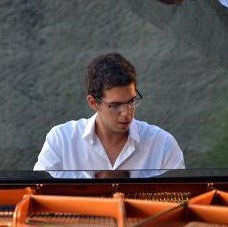
Seeing him sitting at the piano, one could already observe that Salih Can Gevrek is a calm and calculated man. He wasn’t here to fling his head into the piano, but he WOULD deliver the passion when the music calls for it (and SPOILER ALERT: he does in the Rachmaninoff!).
Salih started off with Bach’s Prelude and Fugue No. 20 from the Well-Tempered Clavier Book II, but in no way did he bring the audience back to the Baroque period. Under his fingers, the prelude and fugue sounded fresh, unfamiliar, improvisatory and even eerie. He showed how chromatic Bach’s music could be, and although it wasn’t dissonant music, it was definitely not familiar C major territory. The stop-starting subject of the fugue had a strikingly different character to the more mellow prelude, and Salih showed it clearly. The fugue kept me on the edge of my seat from the beginning to the abrupt end in A major. Needless to say, I was very impressed.
I was surprised that Salih chose to play Chopin’s Variations Brillante, op. 12, in the Leeds. I don’t think I’ve seen many people choose this as a competition piece; in fact, this rare gem by young Chopin is rarely performed nowadays. Having played it myself in a competition, I found it really satisfying to perform since it ended with a great flourish. Salih really kept the light character of the piece as he played, bringing out inner voices whenever there was the opportunity, but to him the piece seemed like a piece of cake. It was a great performance, but after hearing it from a professional pianist, I seemed to feel less satisfied by the piece. Maybe there is a reason it’s not Chopin’s most loved pieces. Maybe I liked it before because it was so challenging–and definitely not a piece of cake–to me. I wonder…
To close his act, Salih chose three of Rachmaninoff’s op. 16 Moments Musicaux set: no. 2, 5 and 6. He was very economical in his use of the pedal, which I thought was very nice, especially since it made what he was playing very clear. No, he didn’t hide behind the texture; he made himself as vulnerable as if he was playing Mozart. His show-closing piece, Rachmaninoff’s sixth and final Moment musical, put at rest any doubts about him as a virtuoso. At times it seemed he was playing with six hands and yet he managed to play with such clarity!
I look forward to hearing Salih play Bach’s majestic Partita in E Minor, as well as some of Rachmaninoff’s op. 32 preludes, the composers of which I believe he has now established as his trademark go-to’s, in the second round.
Listen to Salih’s first round performance here: https://leedspiano2018.medici.tv/replay/first-round-with-salih-can-gevrek/
Here’s me performing Chopin’s Variations Brillante (plus his etude op. 25 no. 5 in E Minor) back when Chopin definitely was not a piece of cake: https://www.youtube.com/watch?v=O9pVA6nMfTU
Yilei Hao, 21
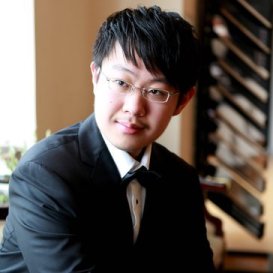
At the mere age of 21, Yilei Hao looked…so old! Honestly he could pass as a young Chinese professor in his thirties, but not a kid barely older than me!
In this performance, Yilei presented two very contrasting sonatas: Haydn’s Piano Sonata in G major, Hob. XVI: 6 and Scriabin’s Tenth Sonata, op. 70.
I have never seen someone with such poised fingers! While he was playing, his fingers were poised high in the air like the tail of a scorpion about to sting the ivory keys, and I cringed not only knowing how much effort it would be for me to remain in that finger position for 25 minutes, but also hearing him stab at the piano during mellow passages in the Haydn.
Honestly, Haydn was boring so I don’t have much to say about it. I went on Facebook.
Scriabin was more interesting. The Sonata is known for its tremendous amount of tremolos and trills (sorry couldn’t help alliterating!) and great complexity. Yilei’s technique was impeccable–he could trill with any finger–and so Scriabin was delivered in a convincing manner.
Yet, as you can tell from my short review, he has failed to impress me.
Listen to Yilei’s first round performance here: https://leedspiano2018.medici.tv/replay/first-round-with-yilei-hao/
Mario Häring, 28
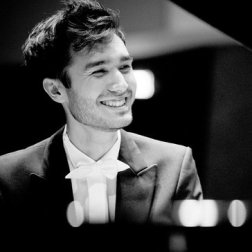
Like Yilei Hao, Mario Häring offers up two contrasting sonatas in his first round: Beethoven’s 6th Piano Sonata, op. 10 no. 2 and Prokofiev’s Third Piano Sonata. Both sonatas written in the respective composer’s youth, one can imagine the amount of energy required to play them back to back, and Mario offers just that in his playing.
His Beethoven was so full of contrasts, and played with youthful vigour. Mario was daring in his tempo, and so involved with the music one would dismiss a wrong note with a flick of the wrist like a posho. Mario showed off his technique in the third movement of the Beethoven, playing the imitative music at breakneck speed. He emanates intensity with his playing, unlike Salih Can Gevrek, who played in a calmer manner. Yet I was equally transfixed by both.
Mario’s performance of the Prokofiev was also fresh and exhilarating. Having learned the sonata myself a while back, I’m quite familiar with its difficulties, but I was surprised at the way Mario saw the music. Above the driving rhythm with its tempestuous character that permeated the one-movement sonata, Mario let a humourous melody break through the registers here and there, wittingly alternating with the tempers of the lower register. I was really taken aback, but I absolutely loved it. Now that I think about it, it did seem that the sonata kept a light-hearted tone somewhat despite all of the brash chords, and I’m glad Mario highlighted that for me. Also, the sonata is such a great way to end a performance.
It seems like Mario is a fan of early Prokofiev, as he will be playing the composer’s second Piano Sonata, along with Mozart’s Piano Sonata in F, k. 332 and Kapustin’s Concert Etude, op. 40 no. 1, in the second round. I look forward!
Listen to Mario’s first round performance here: https://leedspiano2018.medici.tv/replay/first-round-with-mario-h%C3%A4ring/
Photo source: https://leedspiano2018.medici.tv/candidates/
 Literally Left-handed
Leave a comment