As the lights dimmed on hundreds of enthusiastic heads bobbing around the Barbican Concert Hall, a much-missed voice boomed:
“Good eve–good afternoon, ladies and gentlemen…blah blah blah…lovely to have you back…social distancing…face masks…enjoy your concert.”
Never mind the mistake at the beginning of the speech, which reminded us of how long it has been since we last sat next to strangers listening to music together. The Hall was charged with a fraternal atmosphere; this was a celebratory event where one could only express joy through clapping; and boy, the audience was ready to clap at anything.
Who knew that mistake would pile upon mistake, and I would leave the matinée concert feeling disappointed by the biggest stars of classical music, and feeling slightly guilty for not enjoying this first post-lockdown live concert more.

Yuja Wang’s Rach 2
Grieg’s The Last Spring, which opened today’s concert of crowd-pleasers (Rachmaninov’s second piano concerto and Beethoven’s Symphony No. 5, you can’t get any more imaginative than that), was really nice, but in truth we were all waiting for the flamboyant Yuja Wang to sweep the stage.
But not without a bit of commotion. Just before she appeared, a stage hand went up to the concertmaster and whispered in his ear.
Who in turn whispered to the violinists around him, who whispered across the sections, until suddenly the whole orchestra was alive with chatter. Some were even fiddling with their instruments as if there weren’t hundreds of live music-hungry audiences below waiting for the show to begin. Having no idea what was going on, we could only smile embarrassedly (under our masks) at how bad the orchestra was at acting casual.
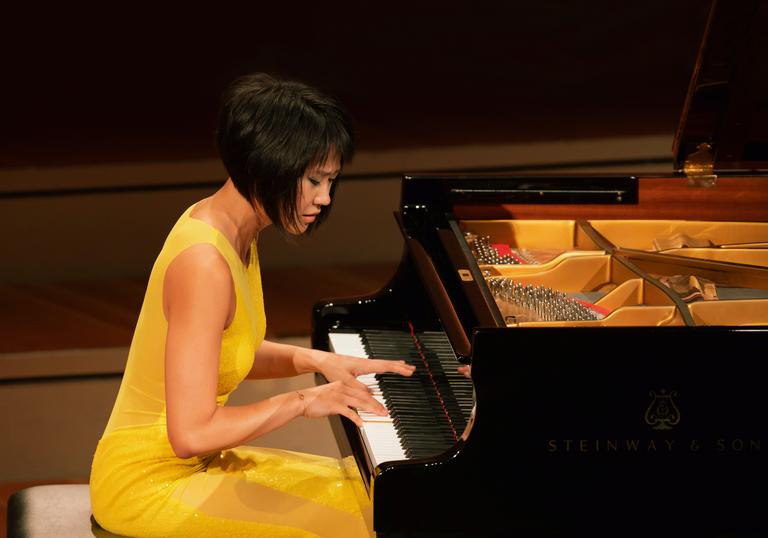
And then just as suddenly, Yuja Wang appeared in her signature bright yellow dress that showed off her brilliantly well-kept figure, did her signature bow, and sounded the first of the bell tolls which begins Rachmaninov’s melancholic concerto.
It’s unfortunate that this concerto is so well-known, and especially to me, because barely a minute in I knew something was wrong. The orchestra was horribly out of touch with Yuja’s tempo. The violins could barely catch up with Yuja’s strides. The brass section at the back of the hall might as well have been behind a hill; they were sometimes a beat late.
And it got worse and worse. Yuja, probably having given up on matching with the orchestra and blatantly ignoring Michael’s attempts except for a few nods, seemed to be playing according to her own whims, speeding up and slowing down whenever she felt like it. She was like an impatient child who longed to run to the playground, but whose incredibly boring parent would not let go of her hand.
As someone who knows the concerto quite well, it was hard to watch two big personalities fight over the tempo, forgetting the music altogether. At one point I wouldn’t have been surprised if Yuja simply stopped playing and left.
It wasn’t wholly the orchestra’s fault, either. I could feel Yuja losing interest as she went on, possibly exasperated at pulling along a very stubborn orchestra. She played without intensity, phrased off strangely at times, and simply glided along weightlessly at others.
She didn’t even bother coming back for a third bow.
I think the reason the stage hand came onstage before her was because Yuja and Michael were fighting backstage.

Michael Tilson Thomas’s Beethoven 5
Now that there was only one tiger left in the mountains, I thought things would look up.
I was wrong.
The tempo Michael chose for Beethoven 5–such a well-known piece–was just a tad bit slow, and that made all the difference. Normally a slower tempo meant more space for loftiness and grandeur in Beethoven 5, but sadly that was not the case, and so what we had was a lack of energy and excitement so characteristic of this epic piece.
To be fair, Michael did add his own touches to, say, the exposition repeat of the first movement, and the voicing was very clear, but for me it just lacked the energy. Sometimes it felt as if the orchestra wasn’t cooperating with Michael very much. He could be swinging his arms in wide arcs and it would only make the slightest difference in tempo or dynamic. It was as if he was dragging Cerberus for a walk, and Cerberus would rather sleep.
The only time I thought the energy picked up was in the finale, but the tempo taken meant the repeated C chords had already become boring by the time they reached the dramatic conclusion.
I feel slightly snobbish for bashing a concert, especially when many around me were so happy about it. I suppose it doesn’t help that the programme included such well-known pieces. If it had been more obscure pieces I probably wouldn’t have been able to find fault with them and would probably enjoy them more.
I guess it just shows that even the biggest names in the classical music industry aren’t immortal geniuses, and it really shows when musicians aren’t committed to the music.
It’s also a reminder for myself to give 100% to my every performance.
Or perhaps that I should never go to matinée concerts.
Rating:
2 stars out of 5
Blog feature image credits to barbican.org.uk
 Literally Left-handed
Leave a comment