
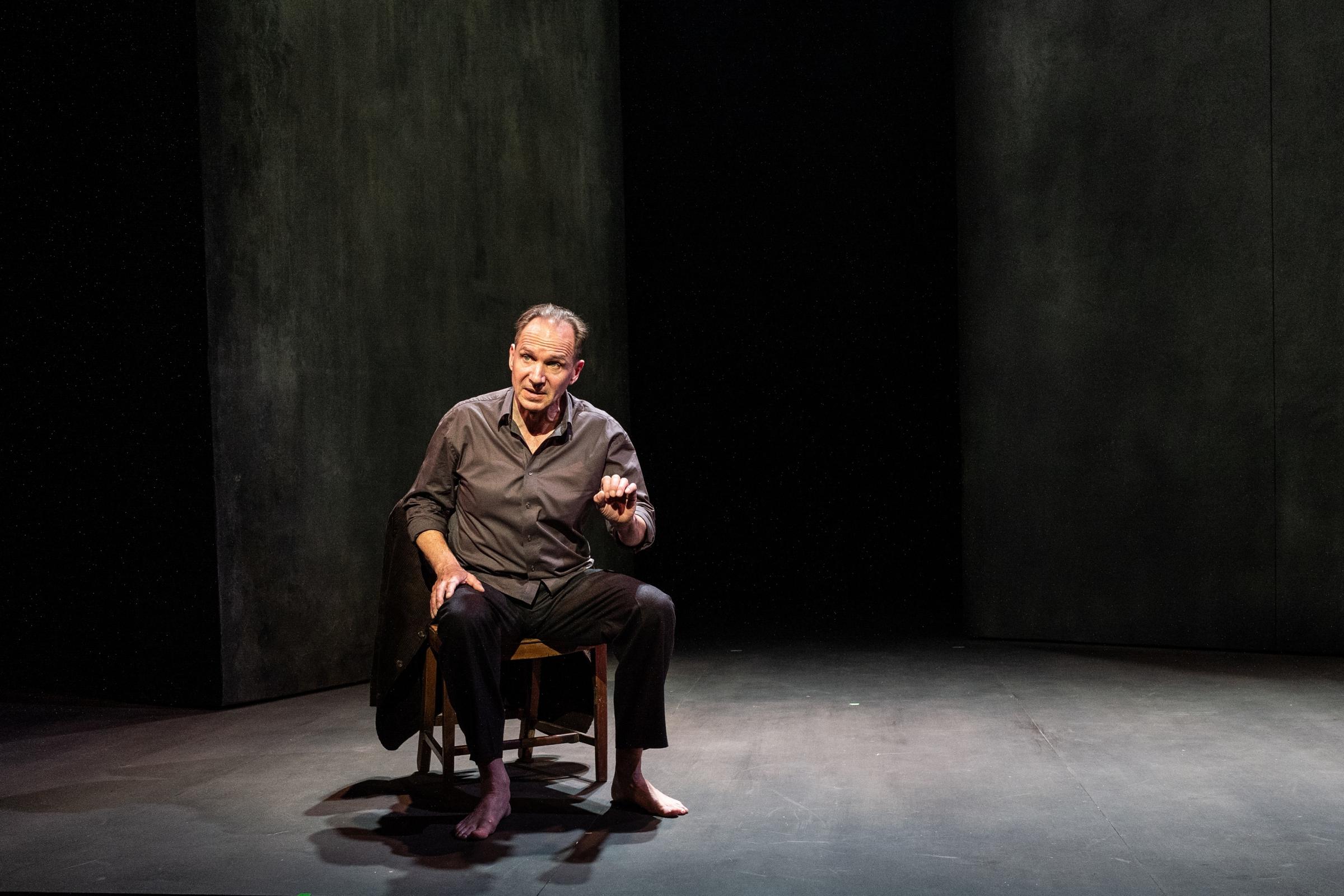
I was invited by a friend to see Ralph Fiennes’ dramatic reading of T. S. Eliot’s famous Four Quartets at the Harold Pinter Theatre last night. Ralph Fiennes is most known for his performance of Voldemort in the Harry Potter series, so watching him perform the dark and existential Four Quartets was quite a jarring experience…or perhaps it was fitting…There were moments when Ralph tossed his head back that I thought I saw He Who Must Not Be Named right in front of me.
I have read, and even studied T. S. Eliot’s poems before, but they never made much sense to me. Some of the imagery and similes just added to the confusion rather than helped. Why would you compare an evening sky to “a patient etherized upon a table”? (Love Song of J. Alfred Prufrock). A lot of times the poems were so abstract I couldn’t follow them, or the narrative jumped around so much I eventually lost interest, but under Ralph Fiennes’ incantatory recitation all the words made sense. For me, it was like hearing an actor perform a Shakespearean monologue; just by reading the monologue I found it hard to understand, but the actor by giving the lines shape also gave me the meaning of the words.
I always thought Eliot’s poetry isn’t quite poetry as we know it. It barely rhymes, and there isn’t a regular rhythm either, much unlike the poetry of Keats or Wordsworth. But I thought it really suited Ralph’s way of performing them. The Four Quartets really felt like they were written to be spoken dramatically on stage, and that’s how I think I should read them; not as rhyming, rhythmic poetry, but as a dramatic monologue.
Last night I had a vague notion of Eliot’s conception of his poetry, thanks to Ralph. He ties the cosmic with the micro together in an extremely compressed way. One minute he is talking about time, (would could have been and what was), about how there is no past or future, the next he is talking about a puddle in a London pavement, or a bush in a village that remains the same for whoever stumbles upon it. Something like that. It reminds me of Virginia Woolf’s writings, where we get a sense that a force greater than all the individuals governs even the most trivial actions of a small character. But that’s the magic in modernist poetry. Even though it is not religious, it is spiritual.
One gets a sense that in every moment there contains something eternal. Here’s a quote from the Four Quartets I loved:
As we grow older
The world becomes stranger, the pattern more complicated
Of dead and living. Not the intense moment
Isolated, with no before and after,
But a lifetime burning in every moment
And not the lifetime of one man only
But of old stones that cannot be deciphered.
As I listened to Ralph and became more and more absorbed by the words, I felt I was listening to some ancient wisdom, and I desperately wanted to grasp on to every word. Ralph’s voice became more than Ralph’s voice (helped also by technology which allowed his voice to boom at times and echo at others). The Four Quartets contained a way of looking at death without the consolation of religion; it refuses to be consoled even at the most desperate of times. At first I thought the whole premise was kinda dark, but I thought it presented a very interesting way of seeing the world; one where nothing new is ever invented, and our desires and fears are simply those which echo those who have gone before us. I find this notion weirdly comforting in a world which seems always to be moving towards some advancement or progress yet never thinking about death and history. Listening to Eliot’s words through Ralph, I felt connected–very connected–to the past, and that was quite a magical feeling.
Today was particularly foggy and humid, and as I walked along the River Thames, looking across to the buildings and skyscrapers shrouded in mist, to the couples warmly wrapped up strolling along the Queen’s Walk, I suddenly had a sense that I was in a moment in time I had never been before; perhaps I was in the early twentieth century, I don’t know. And then I remembered Eliot’s poem, and how nothing ever changes even as we live and die; fire and water remain. The Thames has been flowing since the birth of memory. How many people in the past have strolled where I did today, thinking the same thoughts? How weird to think that we are all connected by the ground, by water, and ultimately by fire?
From what I can tell from that poetry reading, history is also very important to Eliot. Not because it provides us with lessons on what not to do the next time round, or gives us a sense of linear progress (he scoffed at the superficial evolutionists) but because these are the traces of our existence. More and more recently I’ve thought about the importance of history. The modern world seems to deny it, think itself better than history. Some have sought to deny history, saying historical edifices and monuments can be scrapped just like that, trying to render history meaningless; others have sought to transcend history, believing that they will not make the same mistakes as their predecessors, and that they can strive towards a perfect society.
That is why history is so fascinating; these desires and fears keep repeating themselves. I must thank Ralph Fiennes for uttering Eliot’s timeless words of wisdom for me last night. I really must start reading the Four Quartets.
P. S.
After the show, my friends and I went to the pub and bumped into two strangers, a couple of whom one is a poet and started reciting Eliot to us! Literally metres away from the Harold Pinter Theatre where we just came away from a poetry reading of T. S. Eliot! Oh, the people you meet in Soho! Another jarring experience; to hear a drunk man in the pub reciting the sober poetry of Eliot right after witnessing a dramatic, revelatory performance of the same poem by the great Ralph Fiennes. Saturday nights in London are full of surprises.
 Literally Left-handed
Leave a comment