
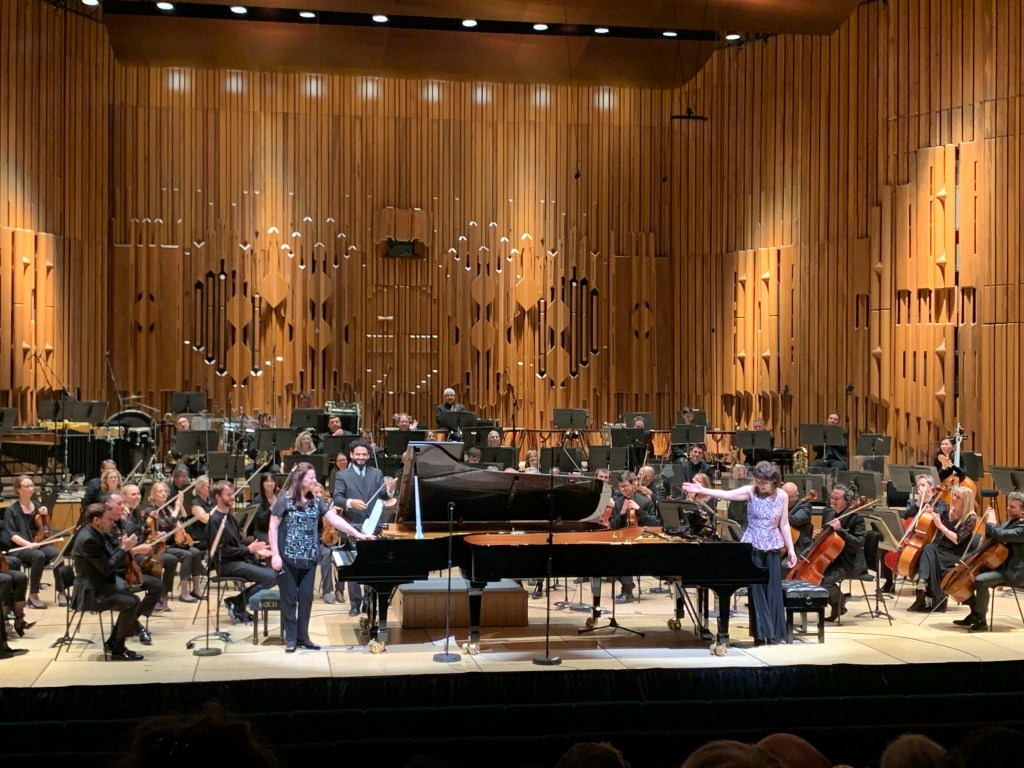
How often do you get to see your piano teacher as a soloist (or would it be dualist?) in concert with the BBC Symphony Orchestra? Well, for me last night was a first, and I absolutely enjoyed it.
Last night’s concert presented by the BBC Symphony Orchestra was a concert of novelties. It comprised the UK premiere of Omen by French composer Édith Canat de Chizy, the UK debut of Canadian conductor Jordan De Souza and the presentation of something rather fresh to my ears by a composer who is no stranger to the English: Ralph Vaughan Williams’ Concerto for Two Pianos.
Unfortunately, de Chizy’s work–composed in 2016 and opening last night’s concert–failed to leave a good first impression on the open mind which I kept for it. Even though the opening of Omen invited intrigue and suspense, the music did not grab my attention. I found the murmuring effect created by the strings rather interesting, and the music gave me a sense of being in a jungle rustling with tension; however, de Souza failed to give direction to music that is clearly poised for action and drama, and my mind wandered unconsciously. At times the music felt lost, and de Souza seemed to be merely giving cues without much intention. Props to the BBC Symphony for navigating such complicated music, but I just could not see the way out.
The assertive flourish opening Vaughan Williams’ Two-Piano Concerto in C major stands in stark contrast to the tense and anticipatory mood of de Chizy’s Omen. Each movement is very distinct in character. Kathryn Stott and Noriko Ogawa set the tone right away for the unfamiliar audience, and from thereon out it was easy to follow the action. I was struck by the use of rather exotic scales in the first movement. As a friend suggested to me, the scales were rather “oriental”; I was very much reminded of Saint-Säens’ “Egyptian” concerto. In fact, the first movement felt like a mix of different idioms: an opening reminiscent of Prokofiev’s First Concerto, scales in the spirit of Saint-Säens; and I cannot tell you how many times the brash, toccata-like music reminded me of a piece I recently performed in the same hall: Lutoslawski’s Concerto for Orchestra. An interesting cadenza led to a second movement chorale which blossomed into the most archetypal, evocative, Vaughan Williams-esque soundscape (read: Lark Ascending, Scottish highlands and the British isles). The third movement asserted itself with a chromatic fugue which was transformed into a triumphant theme for the finale. The cadenza sounded extremely hard to coordinate between the two pianos, but was very well-handled by both Stott and Ogawa. The balance was perfect. Where the music was delicate, everything was sparkly and crystal-clear; where it was grand, the power delivered by both pianos, amplified by the togetherness of both soloists (or dualists) was immense and stunning. All in all, a wonderful performance and a great introduction to a new piece for me. Not exactly profound music, but it was definitely entertaining, unique and chock-full of drama. The surprisingly tranquil ending in B major (I think?) was unexpected but, retrospectively, quite pleasant too.
Given the popularity of Berlioz’s Symphonie Fantastique in modern-day concert programmes, and the sheer amount of time one has to sit for the entire symphony, I should be forgiven for being a bit critical about its performance. I do love the music, and Berlioz’s creativity never ceases to inspire me (not that I think drugs carve out the path to musical innovation), but de Souza’s interpretation of this well-loved piece just didn’t stand out to me as something special. Given that a lot of the music refers to surreal hallucinations and wild dreams, I was hoping for those parts to feel a bit more fantastical and contrasting. Alas, everything seemed very well-mannered to me. De Souza doesn’t take the music to the point of frenzy, which I believe the rapid changes in tempo and harmony imply, preferring rather to stay in control. The result was a rather boring first half of the symphony, where the music feels fragmented and lingering rather than magical and full of energy. I must however concede that de Souza possessed a very strong sense of rhythm, which worked well from the Witch’s Sabbath onwards, making the music very exciting, and thus ending the concert triumphantly. The BBC Symphony Orchestra also produced a very big sound, which made the finale all the more impressive. Nevertheless, I had hoped for more personality in the Berlioz and de Souza’s performance fell short of my expectations.
In the end, I would say only one of the novel experiences in this concert of novelties created a lasting impression, and I’m not just saying this because my teacher was a part of it! Unfortunately, I have seen many exciting conductors deliver mesmerizing orchestral performances in London, and Jordan de Souza’s debut performance with the BBC Symphony last night just did not cut it for me.
 Literally Left-handed
Leave a comment