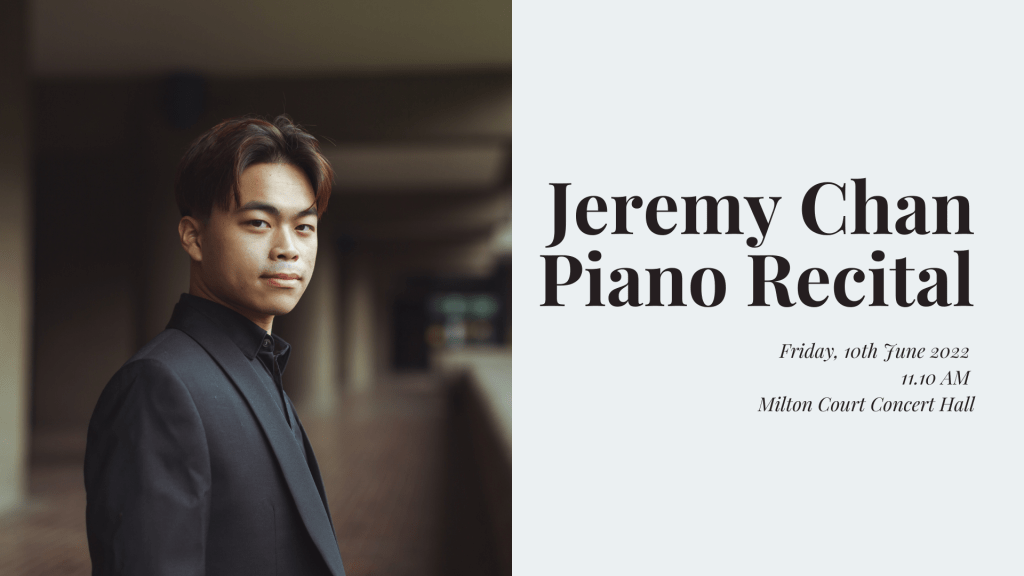
Hello! If you’re reading this, you’re probably waiting for me to come onstage but don’t want to interact with your fellow audience, or you’re bored from watching me play, or you’re so fascinated by the music you’ve just heard that you really want to know more about it; I desperately hope it’s the last of the three.
I often find programme notes at concerts to be dreadfully dull with their objective, third-person description of instrumentations and key changes, so I am going to offer you perfectly biased opinions of the pieces I am going to play / am playing / have just played:
Bach-Rachmaninoff Suite from Partita for Solo Violin in E major, BWV 1006
This is more an arrangement than a transcription, with much of the arranger’s flavours added into the mix; a fitting modern-day analogy would be Rod Stewart singing a cover of Sweet Caroline at the recent Platinum Jubilee concert. You may like the original version better, but before you start complaining in your nasal voice how nothing can compare to Bach Almighty, you must bear in mind that the intention was never to stay loyal to the original. Rachmaninoff spray-painted his initials Banksy-style over a mural of Bach in this creative arrangement of the well-known Partita for solo violin.
Me, I love the piece so much I have wholeheartedly forgiven Rachmaninoff for giving me all kinds of technical frustrations in practice. Listening to the original Partita and then playing Rachmaninoff’s arrangement, I marvel at Rachmaninoff’s genius in being able to delve into the fertile soil of Bach’s music, sow his own ideas–be they motivic fragments or lush harmonies–and watch them blossom and bloom. Rachmaninoff’s creativity is literally bursting the seams of Bach’s music, allowing us to glimpse what we’d never thought we could find in the original.
That being said, even though the retained melodic line of the solo violin is often shadowed by Rachmaninoff’s countermelodies, chords and all kinds of scrumptiousness, after learning the piece for a while, I begin to realize that this thin, silken strand weaving itself through the entire piece is what holds the music together. Without it, Rachmaninoff’s harmonies and motifs would just be bouncing off the walls of a hollow echo chamber. At some point you ask yourself, do you really want to throw away the humble offerings of Bach and throw yourself at the feet of Rachmaninoff, who offers you the luxurious robes of chromaticism and octaves? The answer is no. You don’t have to renounce Rachmaninoff, but you must remember that Bach is the giver of life.
I find it interesting that while Rachmaninoff’s original works are so full of melancholy and so clogged with emotion, he chooses the most boisterous and lighthearted subjects to transcribe (arrange, ahem). While most Romantic composers chose to heavy Chaconne from the second partita, Rachmaninoff chooses the most life-affirming third partita. And then there is the scherzo from Mendelssohn’s A Midsummer Night’s Dream, Kreisler’s Liebesfreud and Liebeslied…perhaps to consider Rachmaninoff as a whole and complete person, we must take into account his transcriptions. Perhaps he’s not as much the brooding melancholic as posterity makes him out to be. On the other hand, maybe it’s precisely because his transcriptions (arrangements, dammit!) don’t fit into this idea we have of him that such wonderful arrangements as this Suite is still fairly underplayed.
Perhaps.
Scriabin Sonata No. 5, op. 53
Speaking of typecasting, our man Scriabin has had it pretty bad too. In my immature mind, he is the bad boy of classical music. During my teenage years, Scriabin is often what you listen to if you want to be counterculture but are still a nerd.
“Dude, you’re still listening to the Liszt Sonata? Man, that is so middle school. Listen to Scriabin 5, or Black Mass if you’re hardcore. That’s the sh*t, that’s what being on drugs is like. Yeah, totally, I’ve tried them.”
Listening to Scriabin’s music, especially the later stuff, is such a distinct auditory experience that one gets stuck on this particular perception. Although the fifth sonata is generally seen as one of the works concluding Scriabin’s middle period, a lot of qualities prominent in music of his later period already feature here; the sense of time is distorted as chords seem to expand infinitely, and there never seems to be a stable tonal centre even though the music cannot be described as atonal.
If I were to give an analysis of Scriabin’s Fifth Sonata, I’d probably be doing a viva voce as a PhD candidate after having pulled all-nighters in the library for weeks on end. Nevertheless, reading on analyses of this particular sonata has given me insight onto aspects of Scriabin I had never before considered. This might be hard to believe, but Scriabin was at heart a formalist. Although it may not seem like it, he does conform to sonata structure. The way he conceives of sonata structure is a bit different to conventional classical sonata form, and even to the Romantic sonatas. For example, the opening passages, which signifies the ‘birth of the spirit’ (more on that later), is used to commence the development section as well as the recapitulation. So what we get is a sense of cyclic recurrence of the same thing rather than a continuous narrative, which is the driving force underlying sonatas from Haydn through Beethoven to Liszt.
Another thing I find fascinating about this sonata is how the melodic motifs essentially stay the same even when they grow from tiny murmurings to transcendent climaxes. The melody in the ecstatic finale is exactly the same as when its first materialization as a languid motif, except it has a lot more chords and octaves piled underneath it. Plus, the more I looked into it, the more I realized how interconnected distinct sections actually are, whether through motivic cells or underlying bass notes. When we start analyzing the music of Scriabin, a whole new world of his hidden genius is revealed.
People often link Scriabin to his bogus spiritual philosophy, and call him eccentric. For that reason, his music, while appreciated for its exoticism and uniqueness, is often dismissed from serious study. What we neglect to examine is the way his philosophical outlook informed the way he structures his music. Learning his fifth sonata, first leaping over the seemingly insurmountable hurdle of its technical difficulty, then tackling the equally challenging barrier of analyzing his music–which I’m still in the process of doing–I have discovered that equating his music with ecstasy is really just the tip of the iceberg of what it means to be cool in classical music dialect.
Debussy Images Book I, L. 110
Debussy’s sound world never ceases to amaze me. How he manages to pack so much into these beautiful, compact and deceptively simple miniatures always brings me joy when I ponder the question. Once again, washed away by his accessibly beautiful colours, people term Debussy as an “Impressionist”, mixing him with the painters of the French fin-de-siècle in a swirly palette. In fact, it took Monsieur Claude four years (1901-1905) to painstakingly rework the first Images to perfection. A perfect piece of music naturally has perfectionist demands, and Debussy takes care to tell the performer to play “with precision” in Mouvement, the last of this set of Images (yes, there is a book II, and then Images for orchestra, and then Images oubliées. The man was obviously obsessed with photography by music). Much of the tempo changes are written directly into the music, in that and so any liberties taken by the performer would be frowned upon by Debussy academics, and probably by Debussy himself. So don’t be fooled when you see “Tempo rubato” written at the top of Reflets dans l’eau. Unless you’re the listener, then by all means bask in the illusion created by the perfectionist Debussy.
When I play the Images I often find myself hovering in a rigid state of contradictions. Whilst the lush chords urges one to relax, one must be very careful in producing the subtle colour changes; while trying to create a sense of the ebb and flow of the water, one must be crystal-clear with every single hemi-demi-semiquaver in order to create that illusion; in order to let the music speak for itself and let the stellar beauty of the music conjure emotions in the listener, one must restrain one’s own emotional instincts and play with perfect poise. I think Mouvement embodies one of the greatest dilemmas for the pianist, thus making it one of the most technically challenging pieces for my mind: the triplets must be played with absolute evenness and precision in order that they become the fabric of the piece, yet focusing too much on them would bring them to the foreground and destroy the delicate fabric, transforming them into irritating bees in your bonnet. I’ll say it here and now: Mouvement is mental torture of the pianist.
Then again, the world needs Debussy. The compact and tight structure of each piece, combined with the use of the golden ratio to space out the climaxes, makes it such a pleasure to listen to. But there is a simpler reason: without Claire de lune, what else are students cramming for exams going to queue in their classical playlists after the Moonlight sonata?
Prokofiev Piano Sonata No. 7, op. 83
To conclude today’s programme, and the most efficient way to finish off Jeremy – Prokofiev’s fiery seventh sonata!
Prokofiev was invited to write a celebratory piece for Stalin’s sixtieth shortly after his close friend Vsevolod Meyerhold was killed by the brutal regime headed by the same man. Later that year, he set out to write the three War sonatas (Nos. 6, 7 and 8), which contain some of the most technically difficult, dissonant as well as heart-wrenching music the composer ever wrote for solo piano. The piano music Prokofiev wrote prior to the War Sonatas were largely sarcastic and bombastic, and whenever there are tendencies towards romanticism, the musical themes are often blown up to excessive proportions, as if the composer is showing that he can write beautiful themes, but not without a smirk on his face.
With the War Sonatas, it’s different. It’s personal. The emotional bits are inward looking, desolate, repressed until they suddenly burst into wild cries of desperation. The sarcasm and irony so characteristic of Prokofiev is still very much there, but this time it is dipped in a darkness and pure evil we do not encounter in his early piano works.
If ever there was a piece written for piano which describes a war, the first movement of the seventh sonata would be it. It has everything, from the tanks, the marching soldiers, the gunshots and bombs, to the fleeing civilians, the sarcastic dance of death and the desolate cry mourning a ruined past. To me it’s basically completely atonal; to think Prokofiev organizes his material melodically and harmonically in the first movement is to move further from his intention. Everything is fragmented, and at his most emotional Prokofiev dissolves tonality; that is where sheer suffering lies, when keys no longer relate to each other, but wander without purpose. Still, the sense of structure is very much there; the fragments are very coherently organized and cohere with sonata form; in that we can see Prokofiev is at heart a formalist.
It took me a while to grasp the full emotional force of the second movement, but once I did everything seemed to make sense. We begin with a beautiful melody quoted from one of Robert Schumann’s songs, “Wehmut” from Liederkreis, op. 39, so full of nostalgia, before the music is taken over by a more anxious murmuring in the lower registers. This quickly develops into a whirlwind of emotion, whipping into a frenzy. At the climax we hear the thunderous clang of bells, and as the agitation dies away the bells continue to toll, resounding death knells that will echo down into history. The melody from Schumann’s Lied returns, but this time not without a great sense of bittersweetness.
There – my only paragraph that truly resembles what programme notes should be!
The final, infamous movement needs no introduction, and I hope it’s exciting enough that you won’t be looking at your phone while I’m playing it. Finally, I am done!
 Literally Left-handed
Leave a comment