
Schubertiade: a gathering of friends in an intimate and cozy setting to share music, poetry and all things artistic. Probably originated with Schubert, somewhere in Austria, more than 200 years ago, where his timelessly beautiful masterpieces were first revealed to an admiring entourage of friends.
200 years on, this idea of camaraderie and friendship among artists has travelled across Europe and come to rest at the heart of England’s bustling capital, London, in the form of the London Piano Festival, brainchild of acclaimed pianists Charles Owen and Katya Apekisheva. Inspired by the idea of making music with friends, Charles and Katya–who both enjoy successful careers as soloists and perform together frequently as a duo–started this festival seven years ago and has brought together a stellar cast of pianists over the years, including big names like Alfred Brendel, Enrico Pace and Nelson Goerner.
Inspired by the idea of making music with friends, Charles and Katya started this festival seven years ago
This year is no different. The line-up features Tamara Stefanovich, Imogen Cooper, Noriko Ogawa, Vijay Iyer, Paul Roberts, Dominic Degavino and, of course, Charles and Katya. At its heart is the distinguishing feature of the London Piano Festival, the four-hands gala, entitled–you guessed it–Schubertiade, featuring music by–you guessed it again–Schubert.
In between his busy schedule of concert-performing, festival-organizing and lesson-giving, I managed to catch one of the Festival’s co-founders, Charles, for a quick chat and pester him with some questions to find out more about the Festival’s genesis and noodle from him some tips on how to run a music festival. How would have guessed that backstage snacks are an indispensable part of the festival organizer’s toolkit?

The birth of the London Piano Festival
It was in 2011 when Charles and Katya performed at the New Ross Festival in, well, New Ross, Ireland. The festival, founded by Irish pianist Finghin Collins, had just acquired a second grand piano, and naturally the acclaimed Charles-Katya duo was invited to multiply the number of fingers by two.
“We had such a fantastic time at this festival. It was great for pianists to be able to connect, and that was what inspired us to create something similar in London,” a characteristically buoyant Charles enthusiastically told me through the virtual chat window. It was early morning and I was speaking to him through a screen but one cannot help being affected by his passion.
Good times help generate more good times. Charles and Katya brought the two-piano party to London, and for seven years its liveliness has found a home in King’s Place, whose concert hall was designed by Charles’ long time friend, Jeremy Dixon, also one of the patrons of the London Piano Festival, alongside Dame Imogen Cooper and Stephen Hough.
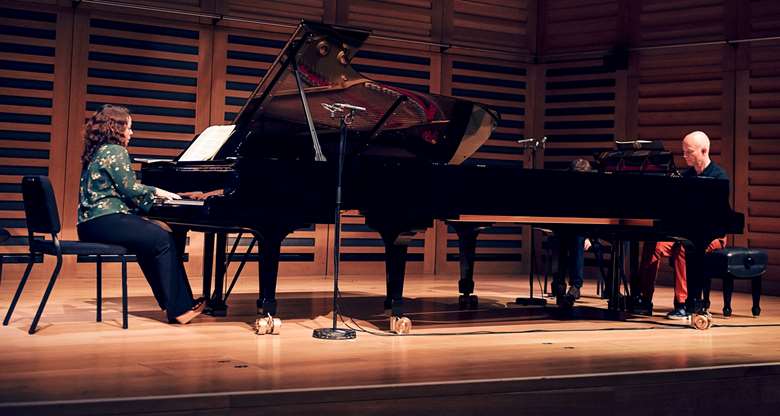
The Festival was actually kicked off by none other than Alfred Brendel who, having announced his retirement from performance, nevertheless gave a lecture on Liszt and cheekily played a little as well.
“You can’t get any better than that to start your festival,” Charles told me. Indeed; what a way to announce yourself to the world of classical music.
Every single festival–apart from the one during COVID times in 2020–had a two-piano gala. This year, for the first time, music for four hands will be played on one piano during the Schubertiade concert, staying true to its Schubertian intimacy. But the festival is so much more than just the boasting of two Steinways.
“Two-piano is a strong thread throughout the festival, but it’s not the whole thing.” Throughout the years, the festival has featured solo recitals, lecture-recitals, poetry readings, book launches and jazz performances. It has even commissioned four major works by prominent composers such as Nico Muhly and Jonathan Dove.
Even Thomas Adès, the pride and joy of British classical music, got involved. “One year we performed one of Thomas Adès’ works and had him come and coach us on it. It was amazing.”
King’s Place
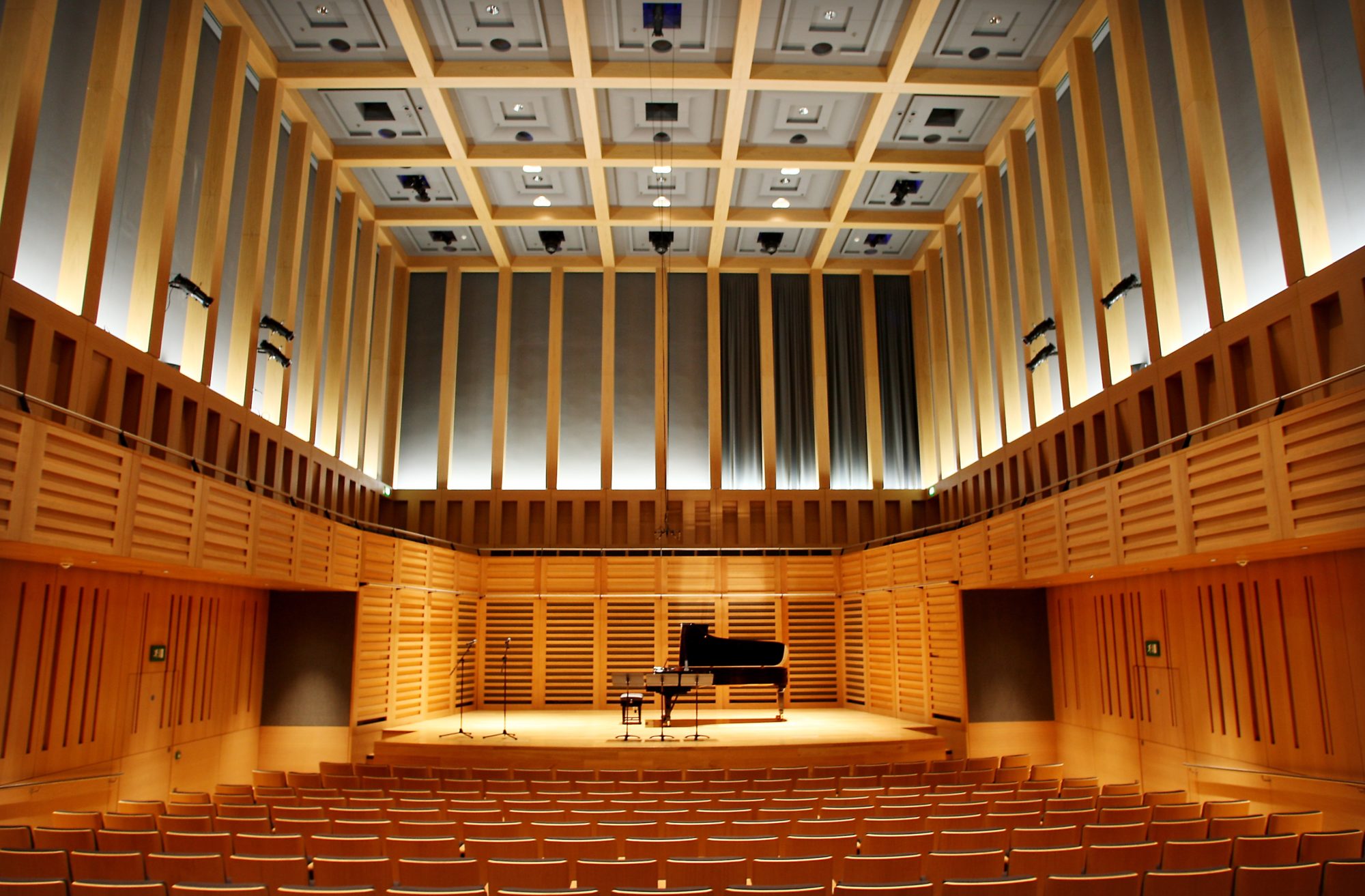
The state-of-the-art concert hall of King’s Place
The Festival’s ethos of bringing together all genres of music to the piano makes it a perfect fit for the venue: King’s Place. A brisk scroll down King’s Place’s website reveals its openness to innovation, cross-genre collaborations, multimedia performances, as well as its embrace of diversity. Almost every evening, audience members from all across London flock to attend poetry readings, folk music performances, jazz gigs and more.
King’s Place is situated right next to Regent’s Canal, on York Way right behind King’s Cross train station, amidst a development that is emerging as the creative hub of London. “It [the concert hall] is part of a larger building which is not just about music. There is so much going on. And the setting, being on the water and all, is just ideal.
“I can’t think of a better place to hold our festival.”
Indeed, when I visited that place, there was a significantly greater amount of thick-rimmed glasses, colourful puffer jackets and what is traditionally known as “funky” shirts compared to other halls (let’s not start pointing fingers), an accurate if not slightly superficial indicator of youth and creativity.
The hall hosts all kinds of performances. While sitting there waiting for concerts to begin, it was fun to picture that the stage with a lone grand piano was the same one that was enmeshed in cables and set up with smoke machines to announce the entrance of a rock band.
The hall is state-of-the-art, the light wooden panelling not only facilitating a warm acoustic, but also giving off a sense of being polished. As Charles said, “it’s contemporary, it’s vibrant, it’s welcoming.”
A Schubertiade
“But the most important thing,” Charles told me, “is the sense of friendship and camaraderie in the festival.” That is the thing that has not changed since Schubert’s time, even as halls have become grander, pianos have become bigger and the audience of Schubert’s music have started to speak English.
“The most important thing is the sense of friendship and camaraderie in the festival.”
In many of the performances in the London Piano Festival this year, the stage is shared by two or more artists, a phenomenon that is more cherished than ever after the difficult era of COVID and social distancing.
Noriko Ogawa and Katya Apekisheva share a recital together, presenting a salivating amount of preludes by two very different composers of the 20th century: Debussy and Shostakovich; Paul Roberts and Charles Owen focus on different aspects of Liszt’s music: desire and religious piety. “It’s one of the most incredible programmes I’ve played,” Charles said.
In the actual “Schubertiade”, Dame Imogen Cooper, long-time patron of the Festival, is finally making her appearance on its stage, sharing the keyboard with Charles, Katya and Dominic Devagino in every combination possible. The thread of mentorship and friendship runs strong here, with Imogen Cooper having taught Charles as well as mentored Katya and Dominic, and Dominic being once a student of Charles at the Guildhall, and of course, Charles and Katya being friends, duo partners and Festival co-founders. I am very excited to see how the interplay between great friendship and musicianship of the highest level plays out onstage.
Charles Owen on how to organise a festival
Of course, what no one likes to talk about is the administrative side of things, but with more people comes more logistical problems. This year’s Festival posed more of those challenges than before because of the railway strikes over the weekend, and Charles found himself busily trying to obtain parking permits for people while practising Liszt’s Légendes.
As primarily a concert pianist, starting and organizing one’s own festival inevitably means a shift in the career gear and becoming a publicist and organizer while maintaining the professionalism of a performer. It also means “learning on the job”. As Charles reflected retrospectively, the first few Festivals were valuable for learning from the mistakes made.
Charles and Katya had to do everything by themselves at the beginning, but it did eventually get easier as they recruited people to help with PR and logistics. Still, they had to sign off on everything, and Charles admitted that the lead-up to a festival could be quite stressful, with urgent emails intruding rehearsal time. Even as we were speaking, he had to apologize for being distracted by an important email that just came in.
I was lucky enough to glean a few tips from Charles on running a festival:
- Have a clear vision of what you want. Partly what made the London Piano Festival successful was the fact that they had a feature which distinguished them from others.
- If you’re working with someone, be clear about what you want and don’t let tensions build up. Working with someone is a necessarily skill since, as Charles told me, organizing a festival on your own is extremely difficult.
- Have some financial backing. The bill can really rack up and you don’t want to compromise the quality of your festival just because of that.
- Have a good core of artists. In the end, the festival is all about the artists and the performances they give. Having a group of artists who are willing to support you even when the going gets tough is important, and having them stick around is also what made the London Piano Festival so successful as the years went by.
Classical music in the Big Smoke
King’s Place is only one of many alternative venues scattered around the Big Smoke where one can listen to classical music. Charles, no stranger to the staple hallmarks of the Wigmore Hall and the Barbican as well as the beautiful churches that populate the city, can also be found performing in alternative venues such as the musical salon café Fidelio in Clerkenwell, central London.
“Fidelio has been really important to me, especially in the last two years. I’ve played four programmes there now. Meeting colleagues in a more relaxed setting is amazing.”
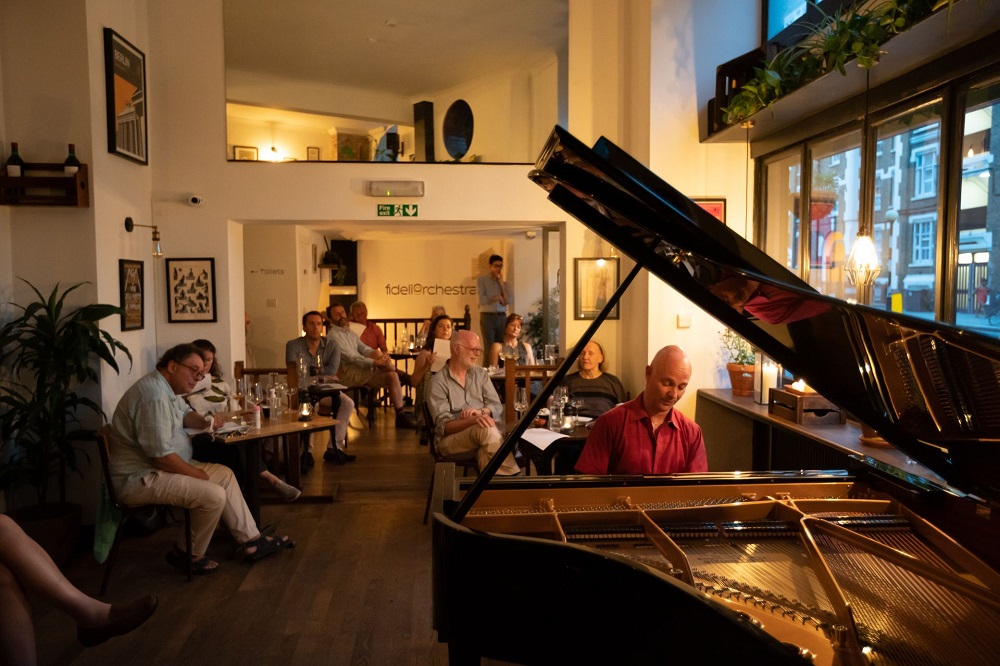
Places like Fidelio and King’s Place are in fact only two examples of a wide variety of venues where one can hear Bach and Beethoven around the capital. Some of the more unexpected venues where one can attend a classical concert include Bold Tendencies, a carpark in Peckham which oftentimes host the Philharmonia Orchestra. Renowned cellist Sheku Kanneh-Mason, as well as others, have also made appearances in underground club venues playing Bach and Boulanger.
“Meeting colleagues in a more relaxed setting is amazing.”
Charles enjoys the innovation in presenting classical music. “Venues are getting less stuffy and more experimental.” It isn’t about having them take over and replace the current establishments. The internationally renowned venues of Southbank Centre and the Royal Albert Hall will always be there, but it is also important to try something different.
“It’s about presenting things differently without compromising the quality of the music.”
The London Piano Festival is part of this fabric, presenting new ideas and music in different ways but never compromising the quality of the performance, preserving the camaraderie central to the sharing of music, a feature which has remained unchanged since the days of Schubert.
Tickets for the London Piano Festival are available here: https://www.kingsplace.co.uk/whats-on/london-piano-festival/

 Literally Left-handed
Leave a comment