
I like to read programme notes before a classical concert.
It lends one an appearance of culture, gives one reason to avoid awkward social interaction with one’s neighbours, but mostly it prepares one for what’s to come, so one will not display indecent decorum by clapping at inappropriate places, and can instead nod knowingly when one identifies the “bell-like sounds” of a particular piece which one has read about in the programme notes, thus demonstrating one’s knowledge of classical music and elevating one’s status in the eyes of the social elite that populate the dimly lit concert hall.
But no amount of programme note-reading can prepare me for a classical concert given by Tamara Stefanovich. In fact, regarding a programme which interweaves Bach with Messiaen, and crisscrosses Rameau with more Messiaen, I would be hard-put to call it a classical concert.
Even though I’ve been to one of Tamara’s recitals not too long ago (an astounding concert, my review of which you can read here), with its characteristically eclectic yet effective programming which often concludes with a beaming Tamara and a terribly flustered page-turner next to her, I was not expecting what I got tonight.
Watching one of Tamara’s recital is like watching an entire series of Breaking Bad; it all makes sense but the ending is the furthest thing you can imagine happening from the first note she plays.
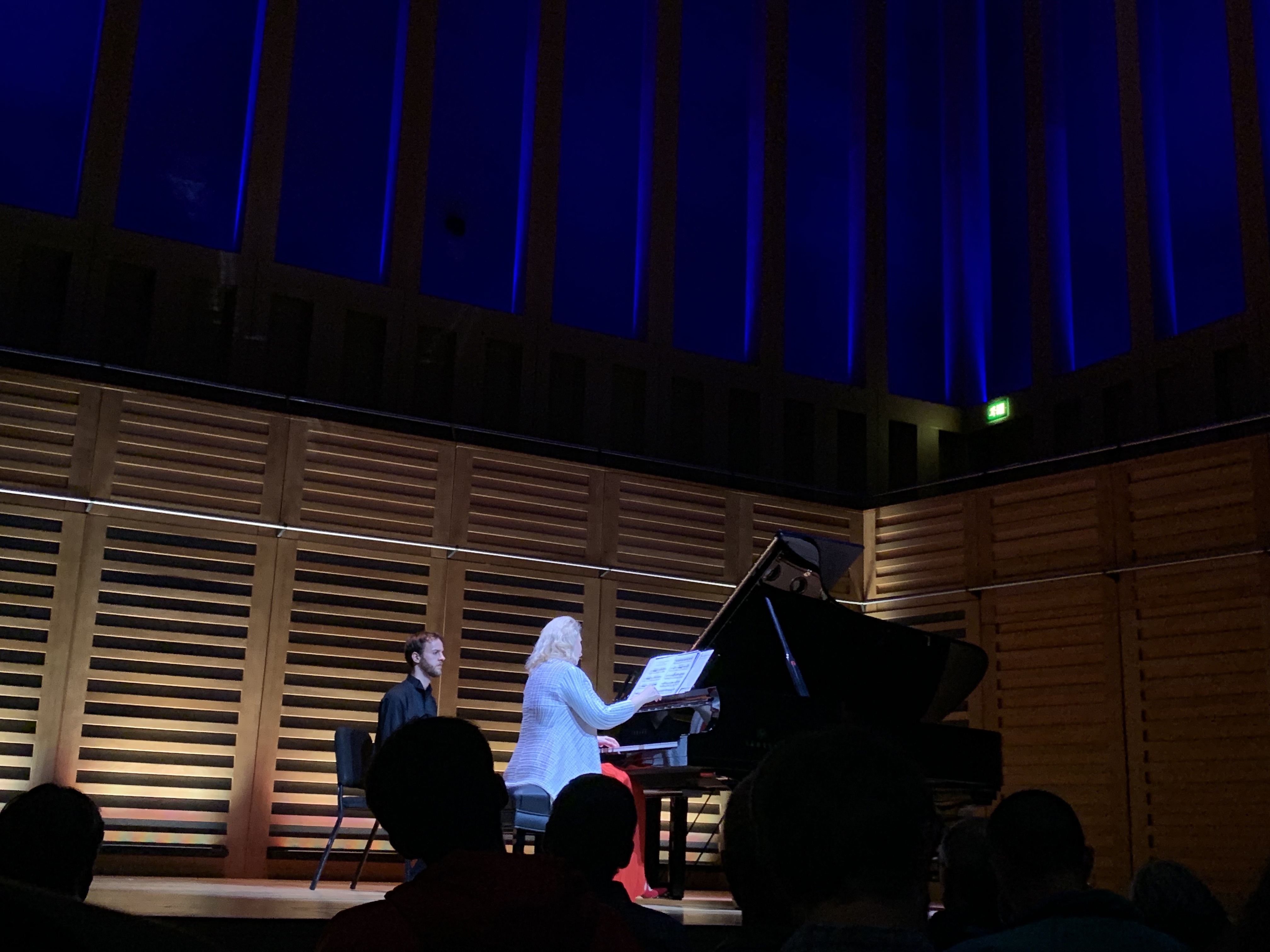
Tamara’s concert, which opens the 7th edition of the London Piano Festival at King’s Place, was a powerful one in every sense of the word.

Awaiting Tamara Stefanovich.
In order to fully deliver the force of her performance, Tamara must play through the pieces without pause. We were instructed at the beginning not to applaud until the interval. So much for my decorum anxiety.
The programme opens with a little-known piece by youthful Bach: Aria variata alla maniera italiana. To me, the style of this lovely little piece is so un-Bach-like it could’ve easily passed for a piece by Scarlatti or perhaps Couperin. It is a light and rather humourous piece, and Tamara performed it with the ease and agility this set of variations requires, and this is no easy feat since, to me, some of the fast runs conjure up the Brahms Paganini variations in my mind. Through the boldness of her dynamic range and the variety of her touch, Tamara told a colourful story that did not end with the last page, but is merely the first chapter of a much bigger narrative.
When the music seamlessly transitioned to Messiaen’s “Chant d’extase dans un paysage triste” from his Préludes pour piano, I realized this was a concert about sound. Tamara is sharing with us the unique soundworld she has crafted using her imagination by linking seemingly irrelevant pieces together. Dictated by her, Messiaen’s music had a great sense of narrative that captured me immediately right after Bach.
When a mournful Bach sinfonia returned after the Messiaen, the chromaticism and dissonance of this little piece became all the more poignant. To put it crassly, it hit me right in the gut.
“Le courlis cendré” (the Eurasian curlew) from Messiaen’s Catalogue d’oiseaux, a last-minute addition to the programme, caught me by surprise. The variety of sounds Tamara conjured from the piano revealed to me how highly perceptive Messiaen was of bird sounds. There was great humour in her playing too, which lifted objective sounds into music. Messiaen’s “Regard des Anges”, the 14th piece in the colossal Vingt Regards sur l’Enfant-Jésus, ended the first half in a flurry of excitement. 50 minutes flew by just like that.
Messiaen dominated the second half of Tamara’s programme, but the order of the programme was still very much guided by Tamara’s aural imagination. A pious “Première communion de la Vierge” from Messiaen’s Vingt Regards opened this half, before Rameau took over with “Les cyclopes” and “La poule” from Pièces de clavecin. I really enjoyed the freedom with which Tamara played these baroque miniatures while maintaining an impeccably clear technique, a licence my obnoxious ear would otherwise not have permitted were this an all-Baroque concert. (I must also give a special mention to Tamara’s perfect trilling, the secret recipe to which I have procured from the master herself post-concert, and which I shall greedily keep to myself.) Tamara’s unique programming gives freedom not only to herself but also to audiences of classical music accustomed to à la carte recitals.
What was interesting was that I started noticing hints of “La poule” in the Messiaen pieces that followed, even if it was just a rhythmic motif! It was as if Tamara was letting me in on an inside joke that spanned centuries, with a punchline that she wrote herself.
You wouldn’t get it; you weren’t there.
After two more pieces from Vingt Regards–“La parole toute puuissante” and “Noël”–the ending I did not expect came in the form of Messiaen’s Cantéyodjayâ, an epic piece inspired by Hindu rhythms. And with what rhythmic drive Tamara played, after having played nonstop for almost an hour! The piece really tests the piano and its performer to the limits, and Tamara went for it without holding back, delivering such a crazy finale the audience had to give her four curtain calls.
Oftentimes, in contemporary music concerts, I find I have to force myself to be open-minded in accepting new ideas. On the other hand, I often find that novelty hard to come by in conventional classical music concerts; one hears what one expects to hear.
By blending aspects from both ends of the spectrum, Tamara shows her audience the beauty in both, opening our minds to new ways of imagining sound as we embark on a journey with her, from the first note of youthful Bach to the last of hedonistic Messiaen.
Her innovative programme combined with her expertise in such a vast range of repertoire calls to mind something Charles Owen, co-founder of the London Piano Festival, once said to me about being creative in presenting classical music: it’s about presenting things differently without compromising the quality of the music.
I would say by doing so, Tamara actually raises it.
 Literally Left-handed
Leave a comment