
Piano concerti of the grandest scale such as Rachmaninov’s 3rd and Prokofiev’s 2nd are often considered summits of the standard piano repertoire which all aspiring pianists both love and fear. However, since its premiere in 1949, a new masterpiece has proven itself to be the Mount Everest of playable piano repertoire, gradually shouldering its way into the standard repertoire, pioneered in recent years by the likes of Simon Rattle and Pierre Laurent-Aimard, Gustavo Dudamel and Yuja Wang.
What makes Messiaen’s Turangalîla Symphony so seemingly insurmountable to even many of the most established concert pianists is not only the amount of notes one has to play, but also the sheer scale and unsoloistic quality of Messiaen’s writing for the piano. Despite playing constantly throughout the 80-minute-long piece, the piano seldom takes on the role of the soloist that dishes out thematic material, as often is the case in Western classical music; after all, Messiaen decided to call it a symphony with piano and ondes Martenot soloists rather than a piano concerto.
Yet William Bracken, final year Masters student at the Guildhall School of Music, decided to take up the challenge early on in his career and embark on the year-long process of learning this mammoth piece, joining the roster of a select few in the world who are able to perform this piece…from memory.
He will be performing Messiaen’s Turangalîla Symphony with the Guildhall Symphony Orchestra tomorrow evening the 23rd of November at the Barbican Hall, alongside conductor Nicholas Collon and notable ondes Martenot player Cynthia Millar.
Recognizing the remarkability of this journey of learning the piano part of the Turangalîla–and playing the celesta part myself in the aforementioned concert–I decided to ask William about his insights on the symphony, as well as his own thoughts on the process of learning the piano part. A born-and-bred Englishman, William chose the pub as our place of rendezvous. Amidst the din of Sunday evening drinkers, politely gulping down his pale ale, William articulately revealed to me his fascination with Messiaen’s musical logic and the unique experience of learning the Turangalîla Symphony.
On the Turangalîla
Jeremy: What is the Turangalîla Symphony about?
William: It’s about love. Love is the main content of the piece. Messiaen was fascinated by the myth of Tristan and Isolde, and he wrote a trilogy of compositions which he said were related to this story. Apart from Turangalîla Symphony, there are also the song cycles Harawi and Cinq rechants. These works explore different perspectives of love in their hierarchical forms; there’s human love, which is passionate, erotic and sensual; then there’s maternal love, which Messiaen is fascinated by; then there’s divine love because of his intense Catholic faith and his desire to express this in music.
In Catholicism they are unafraid of the sensuality of love. There are lots of seductive moments in the Turangalîla, in the yearning melodies and also the delirious outbursts of passion in the fifth, eighth and tenth movements. There are also the tender and tranquil moments of love, such as in the sixth movement, “Garden of Love’s Sleep”.
Then of course, the title itself is derived from two Sanskrit words, turanga and lîla. Turanga refers to time and movement, while lîla is described by Messiaen as related to love. This is a narrative in the grandest sense because it seeks not to move through time but to express it.
J: Messiaen is notable for his incorporation of ancient Indian rhythms in his music. How does he incorporate them in the Turangalîla?
W: Yes, he studied ancient Indian rhythms in great detail. He doesn’t simply assimilate the oral tradition of ancient Indian music into his own, but also the mathematical and rhythmic theories behind the music. The ancient Indian concept of rhythmic symmetry is applied in the Symphony; for example, the rhythm of the first theme of the final movement is symmetrical, so it would be the clapped the same way backwards or forwards. For Messiaen, this symmetry symbolizes the Eternal, because it has no beginning or end.
This symmetry is also applied to the structure. In the fourth movement, the love theme is sandwiched between two Très vif sections, and the second Très vif section is in retrograde of the first one, meaning it is a mirror image of its counterpart, thus creating symmetry. Of course, you wouldn’t pick up on these things just by listening to the Symphony once, but it does create an impression on your subconscious as it absorbs Messiaen’s unique musical logic.
J: Can you feel that this Symphony relates to the Tristan and Isolde myth in any way?
W: Yes, I think it has the same overwhelming quality, the same kind of passion. It’s a feeling that takes hold of you very viscerally. That’s one of the things I felt while rehearsing this music. There’s something so inherently moving that sweeps you right off your feet and takes over your body. That being said, I think he looks in much more detail at his faith than Tristan. Tristan is a more human exploration of love, and while Messiaen doesn’t neglect the human side of love he makes sure to include the spiritual side of it as well.
“There’s something so inherently moving that sweeps you right off your feet and takes over your body.”
J: Around what period of the composer’s creative life did he write this piece?
It is a relatively early piece that put Messiaen’s name on the map. Serge Koussevitsky commissioned the piece, and he gave Messiaen free rein to compose whatever he wanted for a large orchestra, so this was what the composer came up with. It’s crazy. Leonard Bernstein and Yvonne Loriod gave the premiere of the Symphony in 1949, with Ginette Martenot–sister of Maurice Martenot, inventor of the ondes Martenot–playing the ondes Martenot.

J: Why did Messiaen include the ondes Martenot in his instrumentation?
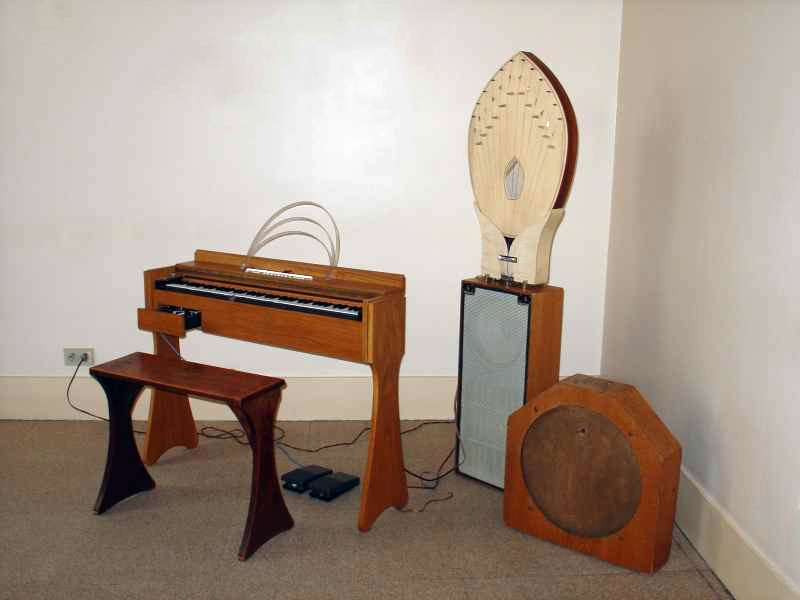
W: He was one of a handful of composers who became interested in the instrument. It plays a very specific role in the piece, where a lot of times it doubles the strings. Its sound has a very ethereal quality; it’s essentially a very vocal instrument, and I think that’s what attracted Messiaen. I’m not sure how this is done–I must ask Cynthia–but it can create a huge range of timbres, and its capability of producing a wide range of colour probably appealed to Messiaen.
J: And what do you think is the role of the piano in the Symphony?
W: It has a largely narrative and structural role rather than soloistic. The cadenzas are not very thematic; they seem to comment, acting as a narrator. It’s an augmentation of what’s going on, and so you have to be aware of what’s going on everywhere, all the time which, with Messiaen, is never easy. A lot of times the piano complements and join in with what’s going on in the orchestra, which have most of the main themes. However, the piano does have the fourth theme the most, played across many movements. It’s definitely a unique way of positioning piano and orchestra, different from anything I’ve done before.

J: You mentioned the piano is like a narrator. Do you think there’s a narrative to this piece?
W: In the most commonly accepted sense of the word, I think no. It doesn’t travel from point A to B. The themes are happening all at once, everywhere, in many different, complicated, yet highly ordered rhythms. That’s the main drive of Turangalîla. In some sense it’s impressionistic; he’s trying to give you an impression, a picture of these concepts of love, to which he returns again and again, but there is no problem to be solved as in a narrative. It’s not a narrative that travels through time because it expresses time.
“It’s not a narrative that travels through time because it expresses time.”
On learning the Turangalîla
J: When did you start work on this piece?
W: Pretty much a year ago, around November last year.
J: How did you begin approaching this piece?
W: I started very lightly. I knew it was going to be big, but I didn’t know just how big it was going to be. I couldn’t see the work in its entirety, and so it was difficult to gauge my progress with it. I decided to chip away at it regularly in quite small amounts, spending half an hour to an hour on it a few days a week, a method which, in hindsight, was a really good idea. I got to about halfway through the Symphony around March this year, and got to the end of the final movement this summer. After that it was a question of cobbling every together, and it’s difficult to practise because there is so much of it! I would focus on one movement at a time, work it up to performance tempo, then move on to another and try not to lose all the work I did with the one before.

J: What strategies did you have to absorb this music which has a language of its own?
W: It’s difficult to say. An interesting that happened was that in the seventh movement there is a rhythmic canon between my two hands, so they play a complex rhythmic pattern of the same three chords–derived from the woodblock rhythm in the fourth movement–but the left hand starts a crotchet after the right, and so the two hands are constantly out of sync with each other. However, it didn’t take long to learn the complicated rhythm, which I found weird until, listening back to the Harawi song cycle, of which a few of the songs I have played before, I detected the rhythmic part in the piano with the same displacement. I had totally forgotten that I had already learned this rhythm because it was much slower in the Harawi song and with different notes.
J: And yet this subconscious knowledge resurfaced when you learned the Turangalîla. There must be something about the ancient Indian rhythms which Messiaen incorporates that touches the subconscious without our conscious comprehension.
W: Another example is in the eighth movement, where I have all these cluster chords in different keys and modes. When I first came across it I had no idea what the chords were–they were definitely not major or minor chords, but something much more complicated. However, when I practised them, I had this weird experience of knowing where I hit a wrong note even though I had no idea how I knew that. It’s like the music has tapped into something within me that I can’t really explain. It’s a weird experience, how music gets into your bones like that.
J: Did you start with the notes and then the logic gradually revealed itself to you?
W: I knew I needed to play–roughly–all the right notes if I can manage it, so I tried to get the difficult stuff executed properly first. But the more I played it, the more I felt there is a level of understanding that is far beyond what you see on the page or the theoretical.
J: The ironic thing is that, and you mentioned this in your own writing, Messiaen was highly methodical and logical in his writing.
W: Yes. I think if he didn’t have his methods he wouldn’t have been taken very seriously. He had this great intellect, but then he transcended all that in order to write music that is expressive and communicative to all of us, and that is something really beautiful. Listening to his music, you don’t really get a sense of the mathematics or that it is contrived. You get a feeling that it is very organic and emotive, which is why it’s so paradoxical.
“He had this great intellect, but then he transcended all that in order to write music that is expressive and communicative to all of us, and that is something really beautiful.”
J: Did you get much help learning this piece?
W: Not really. I had one lesson on it with Ronan, where I played through the piece, and I also played it in some lessons with Martin, but he didn’t have much to say. There’s nothing much to say, really; I have to go on this journey on my own. I think it’s nice that this is just me, and it’s something that I have to do myself.
J: What was the biggest challenge you faced while learning this piece?
W: That’s a difficult question. I did want to do this piece from memory, but halfway through learning it I asked myself, is this possible? Is it worth spending so much time committing it to memory when I could easily read from the score? But I’ve never been much of a reader so I set myself this challenge from the outset. As time went on, the music naturally went in.
Assimilating the music was probably the hardest thing. Not only the sheer length of it, but also the fact that a lot is happening simultaneously; it’s a lot to take in for you body and mind. That’s why it took a long time to learn. Maybe it’s not a technical difficulty per se, but a question of having enough time. Add to that my unfamiliarity with Messiaen, having only played a few of his songs. A lot of listening to recordings went into the preparation, as well as understanding the orchestration and harmony. Knowing the score well enough is very important when playing with orchestra; the auditory experience must be within you.
J: Are you nervous about the performance?
W: No, I’m very excited. I was worried because I found the music so overwhelming emotionally, and after the first full rehearsal I was shaking because it was just such an intoxicating experience. But I had a bit of downtime to prepare myself mentally. Now, I think in the performance I’ll be able to commit emotionally but not let it prevent me from doing what has to be done. No, I don’t feel nervous at all.
I feel so honoured to be a part of this wonderful project. I think it’s such an amazing thing that the Guildhall School is putting this on, and I think the orchestra has done such a wonderful job. There are only things to look forward to.
The Guildhall Symphony Orchestra performs Messiaen’s Turangalîla Symphony under the baton of Nicholas Collon, joined by William Bracken and Cynthia Millar at the Barbican Hall on 23 Nov, 2022 at 8pm: https://www.barbican.org.uk/whats-on/2022/event/guildhall-symphony-orchestra-play-messiaen
 Literally Left-handed
Leave a comment