
Being one of the hot young superstars of classical music, it was only natural that a lot of hype built around Seong-Jin Cho’s solo piano recital at the great Barbican Hall last Monday. Nevertheless, I was still shocked to see the amount of people milling about the foyer before the start of the concert, and witness a turnout that could rival a football match’s. There were old couples as well as toddlers, people dressed in mink and Gucci as well as people in tracksuits; admittedly, the population was mostly Korean, but the sight of this diverse crowd, as well as their complete, cooperative silence during the performance, gave me a surge of hope for classical music. Yes, everyone might have been there for different reasons, but the fact remains that they will take home with them an impression of what Brahms, Schumann as well as Gubaidulina sounds like in the hands of a master.
Since his phenomenal triumph at the Chopin International Competition in 2015, when he was only 21, Seong-Jin Cho has done very well to forge a career for himself, breaking out of the mould of playing only Chopin, a disease that had plagued many past winners of that formidable competition. He recently released an album with a spotlight focus on Handel, which placed side by side three of Handel’s keyboard suites with Brahms’ Variations and Fugue on a Theme by Handel, a Romantic piece with strong Baroque influences.
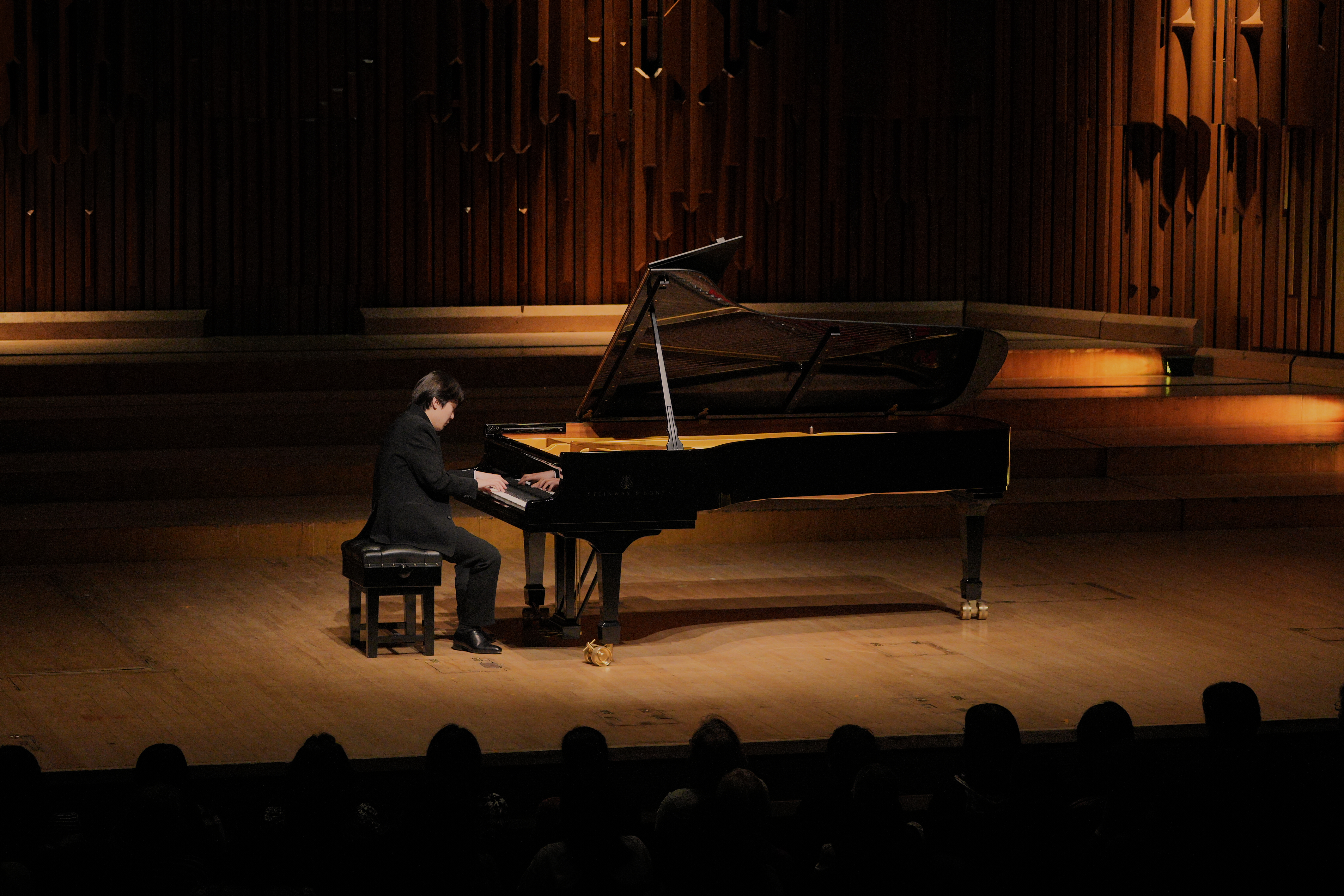
The recital programme on Monday contained some elements of this new album, which demonstrates Cho’s turn towards more Germanic music; the first half saw Handel’s Fifth Suite in E major and the Brahms Variations sandwiching Sofia Gubaidulina’s brutal and disturbing Chaconne. It is a brilliantly varied first half but I have some reservations about it.
It took some time for Cho to warm up to the mood of the Handel Suite. The Prelude felt a little rigid and slightly mechanical but Cho gradually got into the swing of things which made his playing light and charming. There was refined texturing of melodic lines and an abundance of tasteful ornaments in the repeat sections. As I was to find out more later on, the playing was flawless and suave. Cho had a collected air about him.
That air of collectedness shattered immediately as soon as he came back onstage after the Handel and launched straight into the Gubaidulina Chaconne. It was a wild and exciting performance that completely threw Handel-playing Cho out the window; it was my favourite performance of that evening. Cho presented this angular and rhythmic piece–a completely dichotomous piece to the natural and flowing Handel–with clear intention, showing his audience exactly what he wanted us to hear. There was a very clear sense of the chaconne line despite the notes coming out from every register of the keyboard. He was able to build up tension and unleash gigantic climaxes from the force of his physical gestures hammering onto the keyboard; the sound he was able to produce was immense and overwhelming.
Cho’s choice to go straight onto Brahms’ Handel Variations didn’t sit too well for me. Still reeling from the impact of the Chaconne, the immediate commencement of a 30-minute long set of variations didn’t give the audience enough time to absorb the shock of the Gubaidulina, and I found it at times difficult to focus on the beautiful melodic lines in the Brahms. Nor did I sense that there was much to link the two pieces together, apart from the fact that they both pay homage to Baroque forms. Although this was testament to Cho’s incredible endurance as a performer–and the fact that he navigated the incredibly difficult technical passages in the Brahms flawlessly only serves to enhance this–this artistic choice diminished the dignified stature I believe the Brahms Variations deserves. Despite the flawless technique, at times his playing seemed too extroverted and flashy, lacking the introspection and gravity the Variations asks for. The sound from his performance of the Gubaidulina, which worked so well, when carried over to the Brahms, unfortunately made it sound too harsh at times. Nevertheless, Cho is one who knows how to build up to climaxes and he concluded the Brahms with a grand flourish that earned him a waterfall of applauses.
The second half contained solely German Romantic music, opening with four pieces from Brahms’ op. 76 Klavierstücke–a set containing 8 short pieces–followed by Schumann’s grand Symphonic Etudes. The Klavierstücke were very exciting, and it was exhilarating to witness Cho’s incredible light touch, yet it all seemed a little too effortless for him, and the tempo he chose to play the Capricciosos in only served to obscure the stateliness of the dance character in the pieces.
As with the first half, Cho decided to play through the entire second half in one breath, without break. The only thing which links the last of the selected Klavierstücke and the Symphonic Etudes is the key of C-sharp minor; the character is both pieces are completely contrasting. Again I must disagree with this artistic choice; the melancholy of the Theme from the Symphonic Etudes deserves to be set upon with fresh ears. Once again, it is boggling how Cho managed to play the notoriously difficult Symphonic Etudes flawlessly, and the tremendous scale of his sound, able to fill the entire hall, was beyond impressive. Nevertheless, there were times when structure and sense of proportion seemed disregarded in place of more performative whims such as making an incredibly light or incredibly big sound. Nor did the performance sound personal, even when Schumann is at his most intimate in some of the variations. However, credit must be given to Cho for creating a sensational finale with his strong, precise rhythm and the incredible sound he can produce from the instrument, a dramatic finish which drew him endless applause and standing ovations.
It was the performance of a great master and a showcase of magnificent playing as well as impressive endurance, yet Cho for me didn’t bring the personal touch required of the pieces he chose to programme.

All photos credits to Jeongmin Chris Lee
 Literally Left-handed
Leave a comment