
Two and a half weeks ago, I was on an Air Transat flight from London to Montreal. I had just finished my graduation recital (cramming the Barber piano sonata in a month is no walk in the park, would not recommend!), played in a competition (kicked out before I had time to say the word “competition”) and gone through a breakup; an intense period to say the least. Québec was unknown territory, but heading to the Canadian mountains to study music for two weeks sounded right to me. I had stuff to work on, concerts to prepare for, and being surrounded by nature while I worked sounded like what I needed. I didn’t know what to expect, but I was looking forward to it.
To be honest, I didn’t expect much from Orford Musique. I had no idea who was going there, what the standard was like, or even how good my teachers were going to be. Most people often “scout” for prospective professors at these summer academies; I crossed the Atlantic without that intention in mind. All I was thinking when I applied was that I really enjoyed my masterclass with Jean Saulnier–the professor for my first week at Orford Musique–back when he came to my school, and would benefit from having some more insight from him. I also wanted to see what Canada was like. Orford Musique had a beautifully-designed website, and that basically settled it for me. I enrolled in a two-week masterclass course at Orford Musique. Perhaps I should have done some more research before I crossed continents, but it turns out intuition does sometime work in your favour. I hadn’t a preconception of the place and the people, so my mind was open.
Orford Musique, 1.5-hours’ ride away from Montreal, is a well-established and excluded musical hub etched into Mount Orford. It was founded in 1951, which meant that the buildings have a bit of history behind them; not the colonial type with fancy decorations, but the post-war, practicality-over-prestige type. The facilities were drab and ugly, but that didn’t bother me. I was enamoured by all the greenery that surrounded the complex. Tall trees loomed over the concert hall and cafeteria, and the forest was practically tapping on the windows of the dormitories and practice rooms. I knew when I arrived that I wasn’t going to be spending much time in my own bedroom.

I seldom attend large summer academies, and I’ve never attended a multi-instrumental one, so I was curious to see what organizing a hundred young musicians in one place would be like. I was given a room key, told to install an app through which everything is communicated, informed about mealtimes and basically left to my own device. Exactly what I wanted.
The basic premise of Orford Musique is this: the organization provides the accommodation and meals, organizes activities for the students and always has staff on standby to help you. Your life during the week basically revolves around the professor you study with. Different studios–that’s how they call a “class” in North American conservatoires–have different cultures; I got to experience two different studios at Orford Musique and thus had two very different weeks.

When Jean Saulnier walked into the room on the first day of the teaching week with all ten of us sat waiting, he seemed almost surprised that we were all assembled and anticipating; nor did he seem to realize he was already ten minutes late. His unique sense of time was something I would become very well-acquainted with over the course of the week. I volunteered to play that day, thinking it would be good to get advice before Thursday’s student concert, which I hoped to play in. It was also partly to show off; I had prepared Barber’s Piano Sonata, a virtuosic showpiece (and a masterly composition) my performance of which had made a good impression on the jury at my graduation recital. Just the mention of the piece brings you looks of admiration from fellow pianists. Yes, I am that vain.
The student before me played Debussy’s Images Book II. I expected the lesson to last about an hour, like a normal masterclass. When the first hour was up and Jean had only covered the first of three movements, Chris, who was sat next to me and knew Jean well, whispered to me that I should go warm up. “It’s going to take a while.”
In the end, the lesson went on until almost lunchtime. One whole morning to work on a 15-minute piece! There was a bit of time remaining, so Jean asked me to play the first movement of the Barber.
Now, I had already performed the entire sonata. It is a relatively contemporary piece of music, not as subject to centuries of pianistic and scholastic scrutiny as, say, a Beethoven sonata. My main objective for bringing this piece to Jean Saulnier was just to become more familiar with it, get some technical advice and make a good impression.
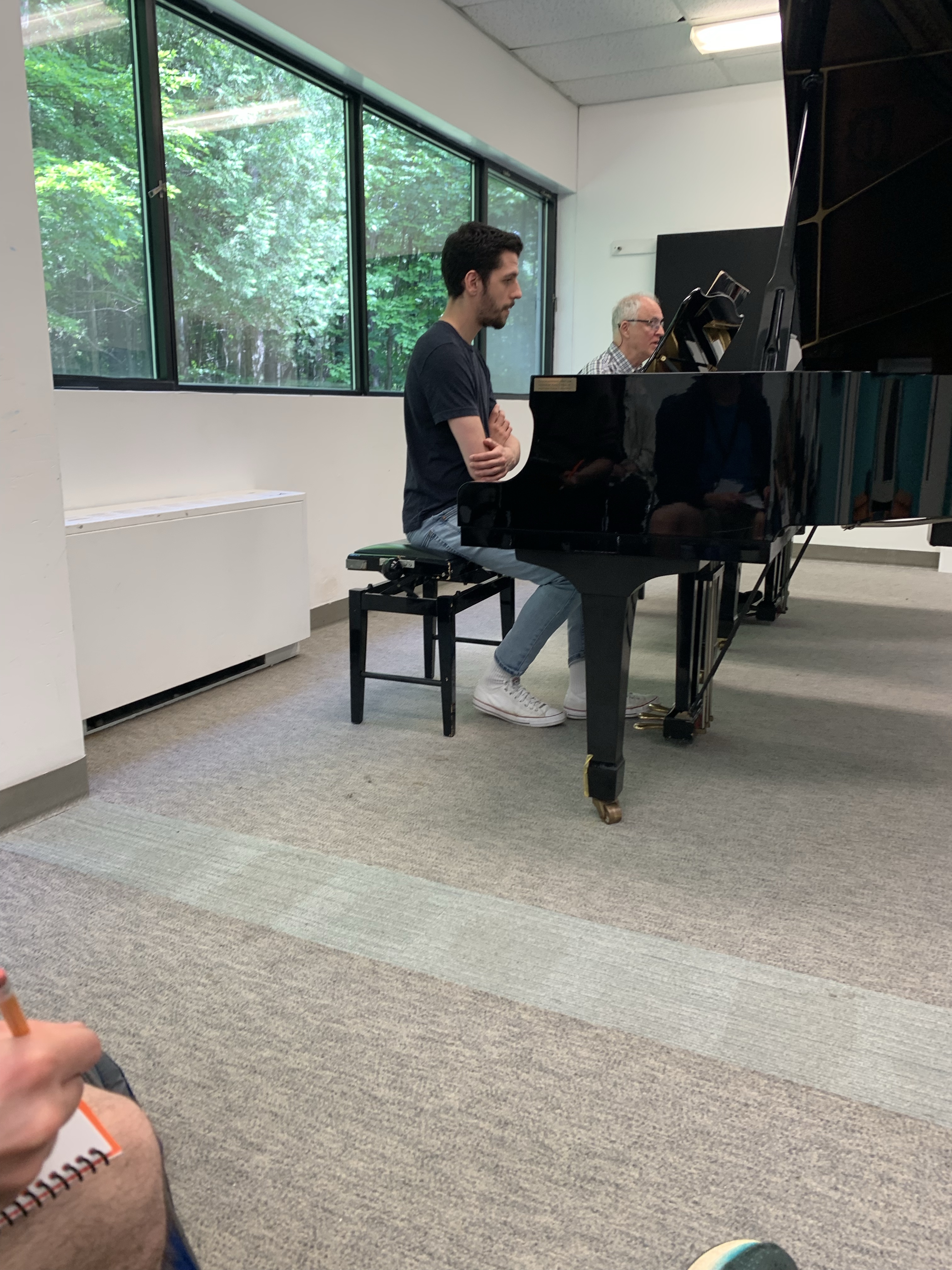
When I finished, he didn’t even bother giving me any of the usual compliments which prelude a masterclass. Jean went straight to saying how my rhythm was too relaxed, that I was too bombastic throughout, and that my posture prevented me from seeing the bigger picture. To be sure, he was nice and friendly about it, but it took some time for my big ego to adjust. Fortunately, we had to break for lunch.
After lunch, we continued work on the first movement of the Barber. The lesson went on for two hours. Two hours on a seven-minute movement! It was probably the most intense lesson I’ve ever had. For two hours Jean introduced new ideas to me about the piece which had never occurred to me: this section relates to that by this motif, this theme takes on a completely contrasting tone to that one, this rhythmic motif should sound like that in order to convey the anxiety inherent in the movement etc. We worked on phrasing every passage, and he made me realize that in my simple desire to learn the notes, I had completely neglected the importance of shaping musical sentences in a rhythm-dominated musical work like the Barber. Jean showed me how contrapuntal the music was, how it contained many layers which must come through heterogeneously and not as a homogeneous muddle. He gave me fingerings which allowed me to shape the phrases more clearly, regardless of how ingrained my old fingerings were. But really, it was when he demonstrated by playing and applying his ideas that I realized he had given me an offer I simply could not refuse. Through him I had become even more fascinated with this piece, and even though he had given me a shipload of ideas I knew would take hours of practice in order to adopt, they are things I had to change, because now that he had shown them to me, I simply could not un-see them. I was converted.
It was a very tiring lesson. Jean made me repeat phrases again and again until he was sure I understood what he was talking about. There would be about ten “hmm, that’s not quite right” before one “yes! That’s it!” In the practice room later, I would learn to adopt this method of self-flagellation. By the time we finished the lesson it was almost dinnertime, and all the students had left. Jean congratulated me on making it through; he seemed just as flustered as I was. The lesson was so intense I had to go for a run in the forests to blow off some steam.

There was no better place to put things into perspective than the forests of Mount Orford. The adamant indifference of the forest, alive with birdcalls and buzzes, offered a calming contrast to the intense musical activity happening in one small part of it. As the weeks went by, I came to realize that the surrounding forces of nature at Orford wasn’t a place to seek solace, but a reminder that what we do in the practice rooms have absolutely no effect on the wilderness surrounding us. That offered comfort to my restless mind, especially when I began to doubt my ability of perfecting a small two-bar phrase in the Barber Sonata, which I spent an hour on during after-dinner practice.
The cafeteria and garage were the two main social spaces for me during my time at Orford Musique. The wonderful thing is that after an intense practice session in which one is alone in a room with his instrument, one can walk a few paces to talk with other people and not have to deal with post-practice thoughts of self-doubt. As the novelty of the place wore off and practice routine became more and more tedious, I found myself lingering more and more in these spaces. Nor do I regret that fact; I didn’t come here just to practise, but to meet people across the Atlantic.
There were three piano professors teaching there in the first week of Orford Musique, and two were from Montreal (Jean Saulnier from University of Montreal, and André Laplante from Montreal Conservatoire). As a result, I met a lot of people from Montreal–past, current or prospective students of the professors–or the general vicinity of Québec. There were even more students from Montreal in the string departments. It was fascinating to talk to them and learn more about their sense of identity. My prior understanding of Canadians was that they were in general a peaceful people who, contrary to their gun-toting neighbours, had nothing much to complain about. Surely in a massive country in which the buying, selling and consumption of cannabis is legal, nothing bad really happens. I was partly right about that; the Canadians were indeed friendly and more subdued than the Americans. However, there are still differences within the country, particularly between the French-speaking Québec and the rest of the English-speaking country.
On my first day at Orford, I got a crash course on Québec history from one of my studio mates. I’m not going to say much here but all I will say is there was a quiet revolution (or révolution tranquille in French) during the 60s from which the modern “Québécois” identity was born (a quiet revolution is just such a classic Canadian move, isn’t it?). Despite being part of Canada, most people from Québec seemed keen to identify themselves as Québécois rather than Canadian–or even French Canadian, for that matter. Apparently there were whispers of separatism back in the days, but those were just whispers…right?
Apparently good looks do not make good politicians, as grievances against Trudeau around the table seemed to indicate. Even though Québécoises and Canadians had no problem getting along, those who knew their history did have qualms about the way they were treated. Certainly the Québécois professors I studied with those two weeks had much to complain about; Jean hated the fact that Montreal’s airport is named after the ex-Canadian prime minister Pierre-Elliott Trudeau (yes, Justin Trudeau’s father).
For someone who has lived in Europe for a while, it is to me a rather bizarre phenomenon that English- and French-speaking peoples could co-exist peacefully without each commenting disdainfully on the others’ lack of taste (mainly the French on the English). Even more bizarre was seeing someone switch between the French and English tongues like it’s a choice between maple syrup or butter on pancakes, without any condescending eye-roll. Notwithstanding this, there are of course varying degrees of English-speaking Québécoises. Most of the bilingual speakers came from Montreal, and within Montreal there are Anglophone Québécoises and Francophone Québécoises. This often denoted a different educational history and background, and hence a differing senses of identity. The Anglophones might be more ready to accept the term French Canadian, whereas the Francophones of Québec might bristle at that it. Anglophone people in Québec could speak French but feel much more comfortable in English; the rest of Canada had to learn French or at least encounter it in their daily lives, but I didn’t hear a lick of French spoken by the English Canadians, especially not to the Québécoises. All this I learned and observed at the dining table in the cafeteria.
Meanwhile, back in the practice building, I continued to have lessons with Jean, absorbing his teaching style and keyboard philosophy, which was vastly different from what I was brought up with. Not only that; even his concept of time was vastly different. He promised to give all ten of us three lessons each for the five-day week, yet his lessons ran on for so long he would often only teach two students during the afternoon. Still, he showed his dedication and care to his profession by extending his lessons into the evening, when most other professors had already finished. Miraculously, he did manage to give me the three promised lessons, even if they did get shorter and shorter.
After the first movement, I brought him the notoriously difficult final movement of the Barber sonata. By then, I had already experienced ego death (not literally) and went in only with a desire to learn and not to impress. Surprisingly, Jean praised me for the work I did on the final movement. He then went on to demonstrate how despite its difficulty, the rhythm in the fugal subject of this movement is actually fun and rather jazzy. Through my lessons with Jean, I realized that having fun and enjoying playing lies at the heart of his teaching philosophy. I grew up with a musical education that stresses playing the piano is hard work. “Lift your fingers up high!”; “Pay attention to every note!”; “Press down harder with your pinky!” etc. I could feel that for Jean Saulnier, everything on the staves is a sort of musical puzzle to be solved, and years of experience in playing the piano did not mean having stronger fingers to play passages, but rather finding easier solutions to difficult passages that allow the phrases to sound more natural. Heavily influenced by the teachings of Leon Fleisher, Jean Saulnier’s vision of musicality is deeply connected with the movement of the hands. The hands should move with ease so that the phrase might flow with ease. With that in mind, he has come up with some rather esoteric fingerings which, on first try, might feel incredibly counterintuitive and different to what is on the page but that, once a lot of practice time has been invested into adapting to these new fingerings, allow the phrases to flow with miraculous ease. It was like turning water into wine, as I later told him.

Once the fingerings were changed and the difficulties of the passage no longer presented a problem, playing the piano should be a rather enjoyable thing. What I felt when I saw him play was that nothing was difficult; everything was natural. Finding the easiest way to play the piano was important to him; the best musical solution was the one where phrasing and the way the hands move fully cohere. I felt like Jean Saulnier had given me the cheat codes to a video game; the only trouble is memorizing them. It didn’t matter to him how much time I had to change my fingerings; that was my problem. All he had in front of him was the musical problem, and all he was going to do was solve it.
If you think it’s difficult to learn something, it’s probably twice as difficult to un-learn it. I spent hours trying to un-learn my fingerings in the Barber Sonata and adopt Jean’s new ones. It was great to work systematically since I knew what I had to do, but progress was SO SLOW, especially when it came to that final fugue. After many hours in the practice room after dinner, I would usually go hang out with the others at the garage.
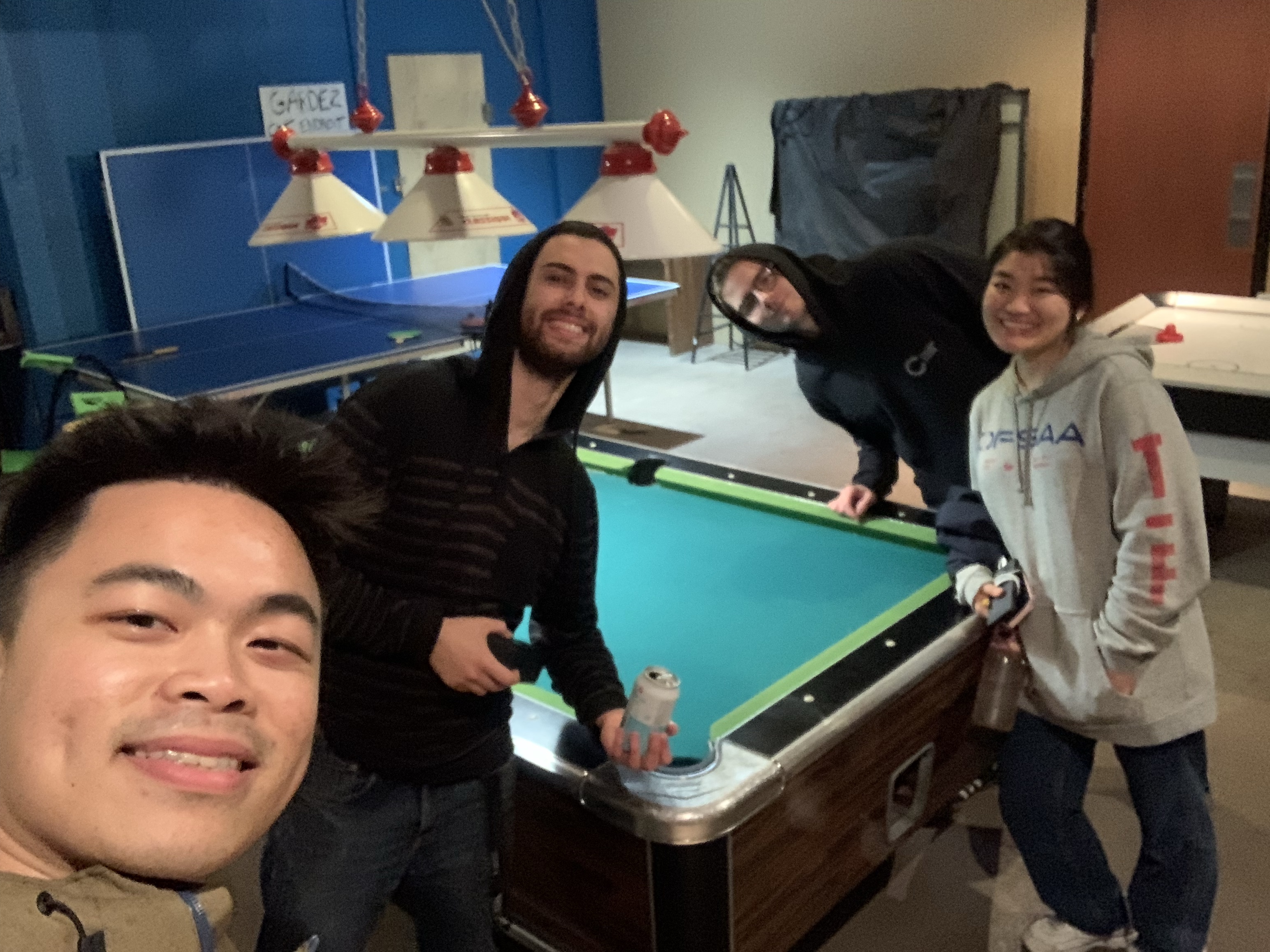
The garage was exactly that: a garage, but furnished with a foosball table (in Québec they call it “baby foot”, how cute!), a pool table, a ping-pong table, air-hockey table and some sofas. You would bring your own beer, someone would bring out a speaker which blared strictly non-classical music, and it would be a good way to forget all your troubles in the practice room rather than bring them to bed with you. Despite having many different instrumentalists cooped up in one spot for most of the day, this was probably the only time I mingled with musicians of other disciplines; most of the day I spent either with pianists or the piano.
It was here that I met a different sect of Québécoises: a group of violinists from the Montreal Conservatoire who basically followed their professor to Orford Musique, so they all knew each other well. They were all very bubbly and more than happy to mingle with others. They were the people who walked around barefeet, meditated daily, wholeheartedly desired to be at one with nature, laughed at religion while embracing spiritualism, believed in the idealism of polyamory; basically neo-hippies. But they were also people who unreservedly believed in the innate goodness of human nature, and would be as generous to you as to their best friend within ten minutes of meeting you.
On the other side of the small room, yelping over the foosball table, were the Americans. Somehow every discussion they had was heard across the room, and every little thing excited them to no end. They would come and go in packs, and had a much wider radius of activity than the garage; oftentimes I would hear shouts coming from the dormitories through which they imported their own version of frat parties, where shots of vodka were no doubt consumed. The shouts would then be heard from a different room, like birdcalls relaying a different party with more booze. Eventually the shouts would be scattered around campus and into the night.
Yet these were also the people who showed up to breakfast on time the next day, and would be heard practising with pitch-perfect intonation before I had even put my score down on the piano.
After three days of intense practice and rewiring my brain for a new set of fingerings, I finally performed the first movement of the Barber Sonata in concert on Thursday. Admittedly, it wasn’t my best performance, but that was expected as I was coming to terms with a new way of understanding the piece. What Jean did give me was a vision of the Barber Sonata that made it fascinating to me, and the idea to always try to understand a piece musically first and find ways of using technique to assist phrasing the music more easily. It heralded a new way of connecting musical understanding with technical playing for me, something that André Laplante was going to take further in my second week at Orford Musique.
TO BE CONTINUED…
 Literally Left-handed
Leave a comment