
Think about a typical evening at Wigmore Hall or Queen Elizabeth Hall, renowned venues for solo recitals and chamber music. Think about the audience filing along the aisles, dressed for the occasion. Think about them sitting down, quietly ruminating over the programme notes, ready to receive the communion of divine musical ideas and inspiration passed down through history. Now turn your gaze on the piano, set on a high altar at the far end of the hall, surrounded by a halo of seriousness. Feel the tense anticipation of the crowd as they await the perfect craftsmanship of the pianist to grace their ears.
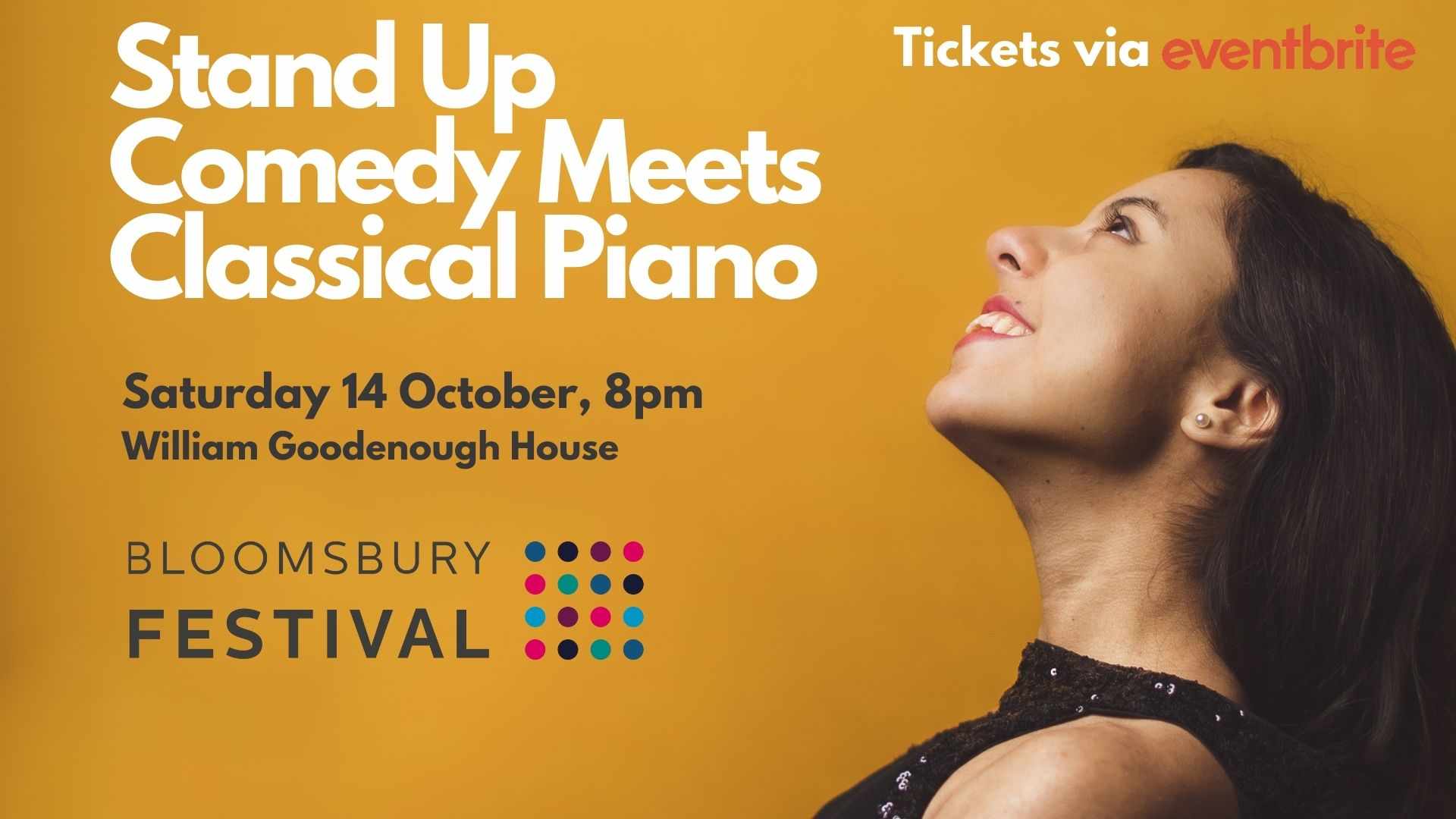
Naturally, it’s not a setting one would associate with humour and lightheartedness. So when my friend Aïda invited me to her classical piano x standup comedy show, I had some slight suspicions. I just couldn’t see how the two things–one which is full of quiet contemplation and truthful, emotional outpourings, the other bursting with laughter and vulgarities alongside the consumption of pints–could go well together. I was worried it was going to end up being neither this nor that; not quite a recital, but also not living up to the standards of a standup comedy show. By the end of the evening, Aïda would dispel all my doubts and show me how wonderfully creative and ingenious she is in presenting her own unique take on classical music.
As conservatoire-trained pianists, we are taught to express ourselves through the piano. To be a good pianist is to spend many hours inside four walls “talking” to an instrument, and therefore an excuse can be–and is often–made when a pianist turns out not to be as communicative and as social as one would expect (in many cases it is an indication of genius). If basic social skills is not a prerequisite of being a performing concert pianist, what of actual presentational skills, where one expresses oneself to an audience not through black-and-white keys, but actually through one’s mouth? Many pianists, despite being wonderful performers, are in fact petrified by the idea of having to present their pieces before playing in a recital and will spend just as many hours rehearsing their brief minute-long exposé as they do a twenty-minute sonata.
Not Aïda. Throughout the whole show, I marvelled not only at how naturally she was able to talk to the audience without fear, but also at how she “memorized” an hour’s worth of sketch material while simultaneously being able to play all the demanding pieces she has included in her programme on the piano. Not to mention all the jokes that run the risk of falling on concrete dead silence. She did not seem at all fazed by that prospect, something I cannot help but admire. But it was exactly this risk that she took, and how naturally she felt when doing it, that charmed us and captured us for the whole hour.
In a way, I think Aïda put herself in a more vulnerable position than most pianists normally do in a modern concert setting. We get to sit behind a score written by someone else and hide behind the notes thought out by a different person. Aïda wrote the jokes herself; she is both the composer and the performer. It takes a lot of courage to put your own work out there by yourself, and that courage was very well-received and admired by the audience of the Bloosmbury Festival that evening.
Nor did the topic of Aïda’s comedy show feel in any way exclusive. You don’t need any prerequisite knowledge in classical music to get a good laugh. Nothing surrounding the culture of classical music was off-limits to Aïda: she made fun of everything in a clever manner, from society’s expectations of a classical musician to the importance of never dating a musician if you are one yourself. She cast her net wide, dipping into political issues and issues of race and religion (there was a really funny joke about Muslim hell, but I cannot spoil it!), choosing about five pieces from very different periods in the piano repertoire to play in between sketches. The themes of the sketches were nicely tied in with the pieces chosen, and for those who are already acquainted with the pieces (some famous pieces such as Ravel’s “Une Barque sur l’ocean” were featured) the preceding sketches also offered a chance to look at the music from a fresh perspective.
Aïda’s show provided an evening of hilarity but also great genuineness from the creator. It is the creation of someone who wants to communicate her love for classical music in a much more relatable and contemporary context, who sees classical music as a way of interacting with modern life rather than being insulated from it. It is the creation of someone thoroughly trained in an ancient art while fully embracing the modern culture of social media and politics.
If you’re a classical musician, Aïda will make you see things differently, and you might just end up laughing at yourself too. If you’re not, she will introduce you to the world but without all the frills and snobbery of the culture that often comes with it.
And did I mention that she’s also an amazing pianist?
 Literally Left-handed
Leave a comment