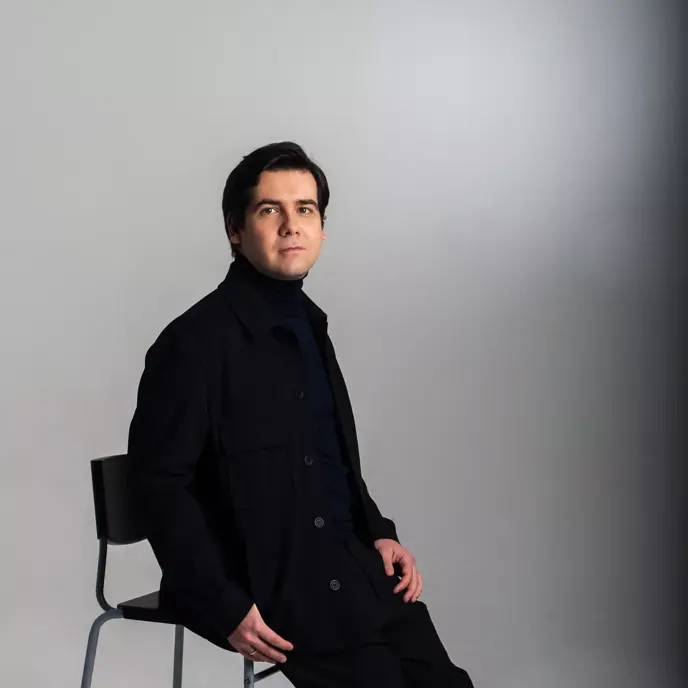
It takes courage and commitment on the part of the audience member to attend a Sunday afternoon recital featuring two ultra heavyweight pieces: Mozart’s Requiem (arranged for solo piano) and Rzewski’s Variations on “The People United Will Never Be Defeated”. But this was Vadym Kholodenko, and people make exceptions for this unassuming yet radically unconventional pianist, as shown by the fairly filled out Queen Elizabeth Hall this afternoon.
For starters, Vadym possesses a technique so incredible it has actually transcended virtuosity. One goes to his concerts not to be entertained by dazzling showmanship, but to simply marvel at a great mind at work, for he sits upright at the piano almost completely immobile, almost as if detached from the incredibly thick textures unravelling from the soundboard in front of him.
I wasn’t a big fan of the Mozart Requiem solo piano version, arranged by Karl Klindworth at the very beginning of the 19th century and basically never performed in public in its entirety. To reduce a piece for choir and orchestra is tricky business, but its technical complexity was no problem for Vadym, who could pull of semiquaver octave runs with–quite literally–a flick of the wrist. Nevertheless, I found it hard to relate to his playing of the Mozart. His rather capricious inflections–heavy rubato as one would expect in Chopin, sudden lightening of tone–just didn’t quite suit the music. It seemed to take away the gravitas of the requiem and reduce its scale. I found it difficult to follow the musical phrases too. At times it seemed like trying to fit Schumann into Mozartian shoes. Nevertheless, it was a good sign to see transcriptions of something as sacrosanct as the Mozart Requiem being allowed into concert halls. It shows that we have truly moved on from the age of puritanism, which at its extreme forbade all Romantic transcriptions of Bach, and even Bach played on the piano (only harpsichord!).
Anyways, Vadym returned to the stage in the second half for the Rzewski, and suddenly everything he did in the Mozart-Klindworth that didn’t make sense to me become heartstoppingly clear in the Rzewski.
I thought a little bemusedly that Vadym, in his black suit sporting a red tie and a pocket square with the Ukrainian blue and yellow colours, clutching his confidential-looking iPad, looked a little like a Labour politician preparing his speech. The irony was that he was indeed playing a piece with very political overtones and–little did I know–about to make a big statement with it.
Rzewski’s Variations on “The People United Will Never Be Defeated” is a set of 36 variations based on the popular Chilean song “¡El pueblo unido jamás será vencido!” that emerged in the 70s amidst political turmoil in the country. It is not often performed, and for good reason: it is extremely technically difficult, and the average performance spans just over an hour, thus requiring not only great technical ability but also endurance.
But as we know, technical issues simply do not exist in a room which Vadym Kholodenko occupies, but I was absolutely floored by his performance of the Variations. He had no trouble taking the piece in his stride, clearly demarcating the theme even as it gets increasingly spliced up. He mastered all the different styles the variations called for, and connected them all into one integral performance while showing this was a composition written by someone who embraced a multitude of genres and styles. His performance embodied all the defiance inherent in the piece, a defiance that was not only apparent in its content but also in its physical presentation, in the way the theme is dissected and splayed across the keyboard, almost threatening to expand beyond the physical limits of the instrument itself. If previously I thought the scope of Vadym’s playing seemed to belittle the scale of the piece, now I found his control of the music even as it threatened to annihilate the keyboard jawdropping. It was this control, this tension between player and music, that paradoxically exerted such violent and potent force on the listener. This was music beyond the concert hall, beyond propriety, music that hit you straight in the face.
It was therefore almost surreal to see how still and upright Vadym remained. He read his music off his iPad and before the performance, gave his bluetooth pedal or whatever small contraption used to “turn the pages” to Michael, his pageturner, who sat next to him throughout the entire performance. Since Michael had only to press a button to turn the pages on the iPad, he also sat very still. So there we had two men sitting relatively still onstage, one with his fingers moving on the keyboard, almost as if they were watching an invisible television, while extremely potent music unravelled before our very ears.
As the music become more complicated, I seemed to experience more of Vadym’s deep and complicated personality. It was in the most complicated bits of the piece that his mind seemed unleashed, and we felt the great power it held in store as we experience Rzewski’s intellectual yet violently raw music. This ridiculously difficult piece of music showed me what Vadym Kholodenko’s great mind was capable of, and it was a performance that shook me deeply by its great intellectuality which carried immense power.
And when the opening tune returned in the end, I felt incredibly moved by its simplicity, as if I myself had been through a great struggle. I had never heard any performance as intellectually powerful as this. In its great intellectual power hides extremely deep emotional feeling. I am left with a feeling I cannot really put a pin on, and I cannot describe what it is that made me feel this way, yet I know this feeling will reverberate within me for a long time, even as I carry on with my normal life. Vadym Kholodenko’s playing may be very unconventional, and at times may not be to my liking, but when on the occasion that he unleashes his full power in his playing, it has the capacity to shatter your conceptions of piano playing.
When I emerged from Southbank Centre into the late afternoon sun shedding its last rays on a bustling Waterloo, I felt I had been to not one concert but two, and could not believe I was still yet to have dinner.
Perhaps the performance also gained its power by its significance given the current political climate of the world. This was a rare occasion in the current world of classical music in which politics spoke so eloquently–or rather, forcefully–with music in the concert hall.
 Literally Left-handed
Leave a comment