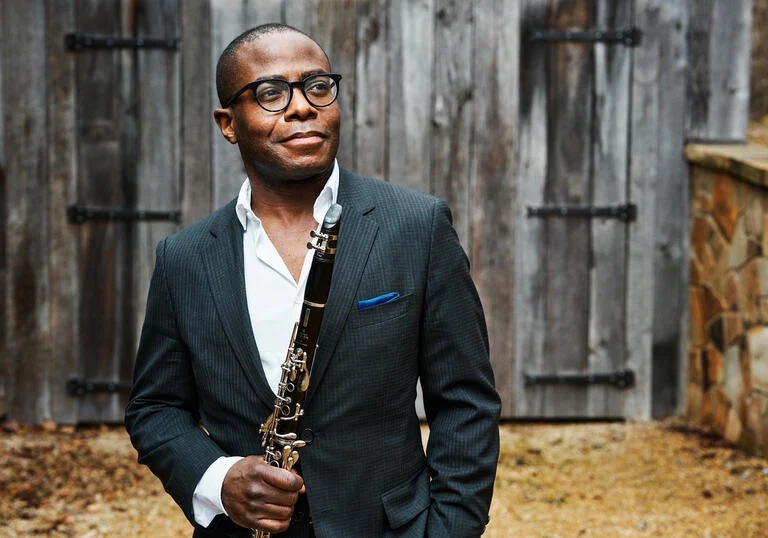
Anthony McGill and the Kaleidoscope Collective presented a fantastic concert last night at Milton Court Concert Hall centring on two major works that incorporates the clarinet into a traditional ensemble structure: Brahms’ Clarinet Quintet and Messiaen’s “End of Time Quartet”. The Brahms adds the clarinet to a conventional string quartet formation while the Messiaen substitutes the clarinet for the viola as normally would be seen in a piano quartet.
This was the first time I heard the Kaleidoscope Collective. They comprise a group of young artists who all have their own solo careers and who are very much in the mood for collaboration and curating concerts with more alternative ways of presenting classical music. Much like the Manchester Collective, their concert drew a crowd different to, and younger than, the Wigmore Hall regulars. “Collective” seems to be the current catchword for the younger generation in classical music.
It was in fact Anthony’s spirit of collaboration that captivated me from the Brahms through to Messiaen, but perhaps more so in the Brahms. Posterity is thankful to the clarinet, for it reawakened the mature Brahms’ composing spirit and turned out some of the most wonderful music the likes we would have never known had the composer never met the clarinettist Richard Mühlfeld. While the Clarinet Quintet was composed with that particular instrument in mind, to me it is a composition which makes use of the clarinet’s acoustical properties and applied it to a conventional quintet structure rather than an excuse to showcase its dazzling virtuosity, and to that end Anthony’s incredible ability to blend his sound perfectly with the strings worked to show just that. His sound is perfectly refined, utterly devoid of harshness or sharp edges, and so perfectly in tune. It was a sound that induced a feeling of satisfaction in you.
I loved how structurally tight the outer movements were in the performance. The coherence in the structural understanding of the players as well as the lack of egoistic playing made for a gripping sense of narrative. One perhaps could have asked for a bit more soloistic playing by Anthony in the second movement, which is more clearly written for that purpose, but Anthony’s constant awareness of his chamber partners meant nothing was ever out of place. At its best, the quintet achieved sounded symphonic in the theme and variations final movement in how they envisioned their sound, and reminded me much of the finale of Brahms’ Fourth Symphony (which was a passacaglia, a kind of variations as well). There was a real sense of tragic resignation when the ending of the first movement returns at the very end of the Quintet, something that I had not noticed before and made it so much more poignant.

What is remarkable about Messiaen’s music is that it is incredibly raw. Rather than write beautiful melodies which convey powerful, at times ecstatic, emotions, Messiaen opts to hit it right at the source, striving to express those emotions (emotions is almost a bland word compared to the music he produces) directly in his very unique musical language, whether this be through his transcriptions of birdsong, ritualistic dance rhythms or harmony so soppy to be almost Wagnerian.
The “End of Time” Quartet contains all that. It contains a whole world of Messiaen’s expressive musical language, and the Kaleidoscope Collective really conveyed all that in their versatile playing styles. It felt like a journey at the end not because of the length and scale of the piece as a unified narrative, but because so many different things had happened that the peaceful, blissful ending felt like an ecstatic release. It really did bring me to a different place, thanks to Elena Urioste (violin) and Tom Poster (piano) who played the last movement so exquisitely and with heartbreaking emotional fragility.
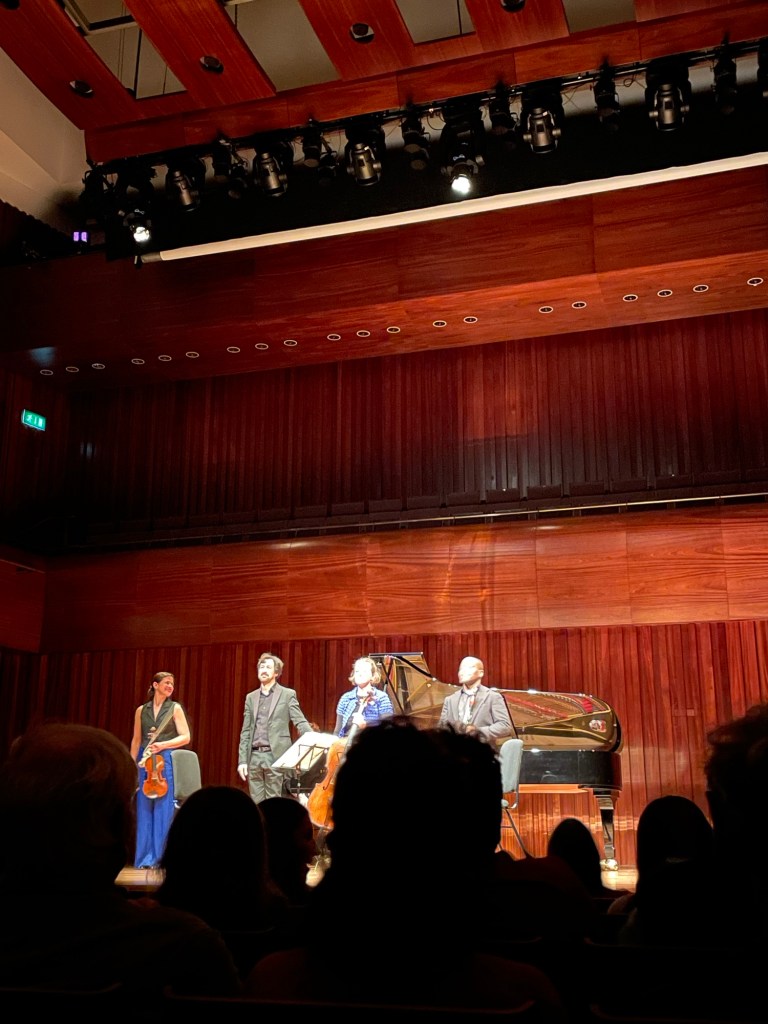
Anthony McGill’s clarinet solo which made up the third movement (“Abyss of birds”) was nothing short of incredible. He really made birds twitter out of his clarinet, and his sound control was unbelievable. His pianississimos were breathtaking, and quite literally too, because you had to hold your breath not to miss the sound, which made it all the more impressive when in that same breath the sound grew to fill the entire hall. It is Messiaen’s writing, combined with incredible skill by its executants, that show how his music quite literally encompasses everything.
Apart from the exquisite moments, there were also exciting and fun-loving moments, brought to life by the passion and vigour of cellist Laura van der Heijden, whose strength strains the music to its edges and brings a strong human quality to the fifth movement, “Praise to the eternity of Jesus”.
The quartet also felt fully alive in the dance movements (sixth and seventh) which in Messiaen represents a raw, ecstatic passion, and the humour of the interlude movement (fourth) was not lost on the players either.
Tom Poster’s piano playing was extremely supportive of the other soloists, colouring the melodic lines with Messiaen’s idiosyncratic harmonies or dancing furiously alongside them. The final movement would not have sounded as if did without his full commitment to the sound as it ascended towards heaven.
Article featured photo credits to Barbican Centre.

 Literally Left-handed
Leave a comment