
The trio brought a diverse programme that fitted the cosy and intimate setting of Fidelio Café in Clerkenwell to a tee yesterday. The small café looking out on the bustling Farringdon Road was packed with diners yesterday as they eagerly awaited the trio. At Fidelio you get the unique experience of exquisite piano music juxtaposed with the occasional motorcycle revving and unloading of bins, very different from the insulated, perfectly balanced acoustics of the Royal Festival or Wigmore Hall.
But this is part-and-parcel of Fidelio’s unique atmosphere, and having been there a couple of times, I’ve realized that with the right music and right performers, one can experience classical music in a different way here, and the performance last night was the perfect combination of all those things.

The evening started off with Irène performing Reynaldo Hahn’s Romance in A major for Violin and Piano, followed by Gabriel Fauré’s Romance in B-flat major, a pairing of light-hearted yet luscious melodies by contemporaries of the Parisian salon scene. Irène was captivating in the way she twists and turns the melodies, making a simple line incredibly nuanced and full of subtle yet all the more beautiful colour changes. The spontaneity with which she seemed to conjure the melodic lines was just as gripping as they were beautifully enticing, and Charles provided a wonderful accompaniment to cushion the sound and allow those colours to bloom, responding occasionally to Irène’s inspired quips with just as much warmth and spontaneity. Both pieces are included in Irène’s upcoming album “Fauré and Friends” which she recorded with pianist Angus Webster.
A wonderful starter to whet the appetite.
Steven Isserlis’ rendition of Schubert’s Arpeggione Sonata with Charles’ accompaniment showed just how much influence a great artist can have on a well-known piece of music. Steven’s authoritative performance shed light on aspects of Schubert I hadn’t come across before. There was something almost Beethovenian in the way he sees the dramatic contrasts in the work, how a tranquil passage can suddenly transform into a wild and frenetic dance. It was a darker and more violent side that I wouldn’t normally associate with Schubert’s music, and yet captivated me all the same.
It was interesting to watch his impassive face as he performed. Yes, he shook his mane of white hair with great aplomb as he played, but ne’er did his facial expression change, always remaining impassive and almost noble. It was almost as if he, together with his audience, was witnessing the ravishing melodies unfold before him.
Between both cellist and pianist, there was a mutual trust and understanding on the music and so the music unfolded as organically and flexibly as if the artists were breathing it out.
Yet Schubert was not the main course of the evening; that place was reserved for Camille Saint-Saëns’ relatively unknown Piano Trio No. 2 in E minor, of which Steven gave an entertaining yet informative introduction. After the absolutely riveting performance from the trio, one can see why it is not so often performed: it is ridiculously hard, especially for the piano, and is comprised of FIVE (not three, or four) movements that seem to be scant relation to each other; the music ranges from the serious and bravura to the parodic and parlour-esque. It would be a challenge to programme it in concerts.
However, I found it extremely interesting and full of catchy moments, the best one being the fugue in the intense finale. Not an easy piece to put together, but definitely packed a punch and brought the roof down on the Clerkenwell diners with such a powerful finisher to conclude a wonderful programme.
Lesson learned: never underestimate Saint-Saëns.
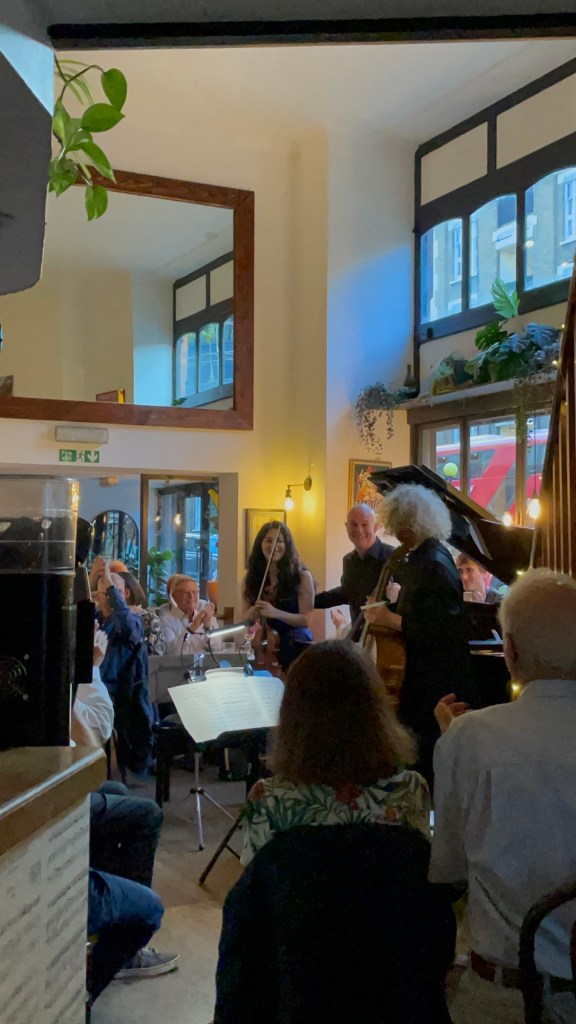
The trio are back for their final concert of the same programme tonight at Fidelio Café.
 Literally Left-handed
Leave a comment