
I’m happy to report that my first experience at a German Opera House was a very good one!
Last night the Bayerische Staatsoper (Bavarian State Opera) put on Donizetti’s “Lucrezia Borgia”, a two-act musical melodrama about Italian families at war, illegitimate children and murderous, cheating wives. Oh, and just casual incest when we realize the love interest in the beginning is revealed to be between mother and son at the very end (spoiler alert? Oops, bet you didn’t see that coming from a 19th-century Italian opera libretto!). The plot may sound terrible and downright incredulous (I was surprised that hardly a chuckle was heard in the Munich audience throughout the whole performance) but by the end of the performance I was surprised to realize the Bavarian State Opera had built so much credit towards their performance that it had shifted my focus entirely away from the story itself.
But first I must sing the praises of the building itself! It was bright and glamorous, creating both a feeling of regality and modernity. Room after room, all polished and glimmering, endowed with chandeliers, gave one the feeling of casually strolling into a 19th century masquerade ball. It didn’t have all the velvet or thick carpets as does the Royal Opera House in London, which seems in contrast to feel rather too heavy and full of itself.
And the seats! I cannot begin to explain how overjoyed I was to discover that gallery seats were also treated with respect and given the width of not half, but one whole person! Sitting through Alban Berg’s Wozzeck squished between two people in the top tier gallery seats of the Royal Opera House in London with no interval was one of the worst experiences of my life.
The Munich audience were all well-turned out too, not lavishly dressed and strutting about like peacocks, but rather stylishly in smooth suits and dresses, and this applied to the audience of box seats as well as galleries! Evidently good taste exists all across the board, or at least Munichers try to make it seem so.
The singing and playing were top-notch. The orchestra was very in tune with the singers, allowing their voices to sail above with ease. There was a certain lightness and roundness of tone that ensured a consistently pleasant sound. After all, this was melodrama, not music that is leaves you emotionally traumatised afterwards. The balance was just right.
The singers were simply incredible. Angela Meade expanded my understanding of what a human soprano voice is capable of after her stunning performance of Lucrezia Borgia’s final aria, notorious for its difficult semiquaver runs and trills, which she delivered with velvety smoothness and unbelievable grace (and which she did the repeat for!). But in terms of the sound of the voice, Erwin Schrott as Don Alfonso had a deep yet penetrating voice which earned the ovation of many after the performance. Maria Barakova rose to the challenge of playing the male role of Orsini and pulled it off with stunning effect, breathing new life into the character.
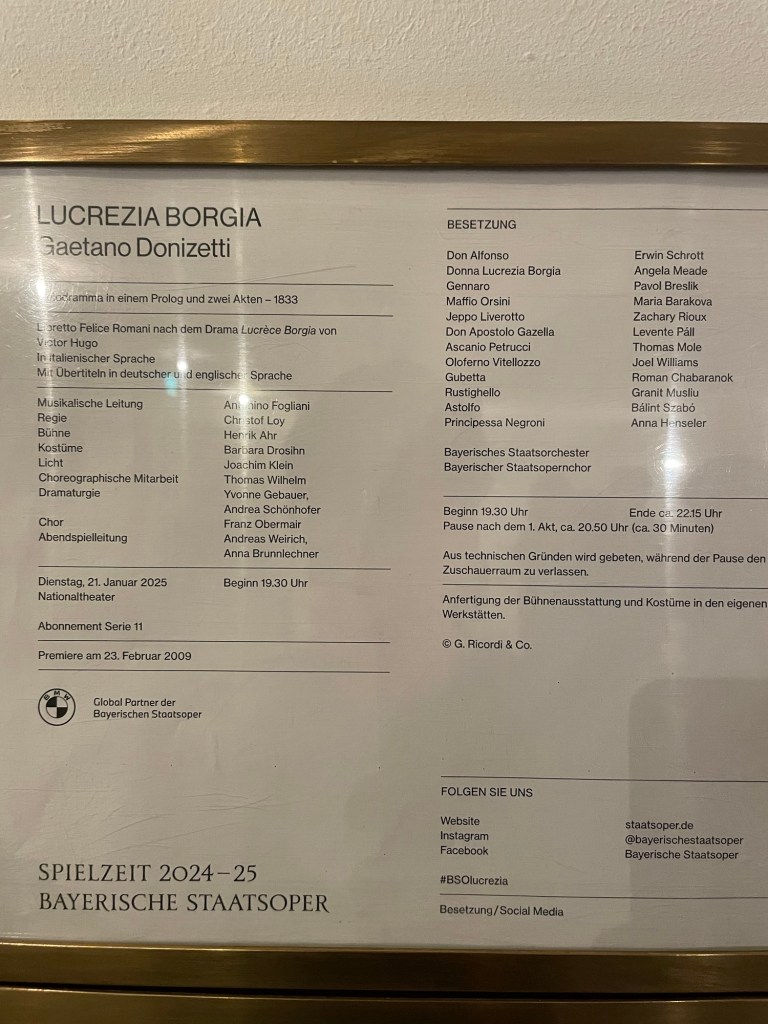
On that note, I did find it interesting casting a female for the role of Orsini, for the brotherly bond between Gennaro and Orsini suddenly had an uncertain edge of eroticism, especially with how close the two actors are positioned together in the duets. That created a new kind of energy, calling into question the homoerotic aspect of male friendships, asking questions that seem more relevant to today’s society in a drama whose plot seems hopelessly antiquated.

I did not take to the staging at first. It was minimalist; each scene often had no more than one or two furniture items (a desk and chairs) or one type of furniture (many chairs), with nothing as backdrop except a white board with the words LUCREZIA BORGIA spelled out in neon light. As the opera progressed, the white board slowly edged offstage, revealing a whole black depth of stage that just isn’t used at all.
Nevertheless, by the end of the opera, I can see how this minimalist setting works better than a more historically informed setting. It unsettles (pardon the pun!) our expectations and asks us to use our own imagination to provide a setting, lending the story a more psychological aspect; what matters becomes not so much what happens but the motivations for the characters’ actions.
The costumes also helped with that. Being a modernist adaptation, the characters were all dressed in suit and tie (not so easy to tell them apart from the audience!) The costume designer made sure to emphasise similarity rather than difference; in any one scene, most if not all the cast members were dressed the same, whether that be in suits or in 70s hippie outfits. Through this artistic choice, the idea of the masses is conveyed. The question of “what will this character do and why” becomes “will this person bend to the pressure of the masses or what is expected of him/her, or will they choose an action that makes them a worthy character?” And in this sense character paradoxically is highlighted through sameness.
I must confess that I am not familiar with the opera at all, and so whether these artistic choices of setting and costume deviate greatly from the original are not questions that I can answer. Nevertheless, it worked thoroughly well for me in making an opera with a terrible plot more lively and relevant rather than simply put on a spectacular reenactment.
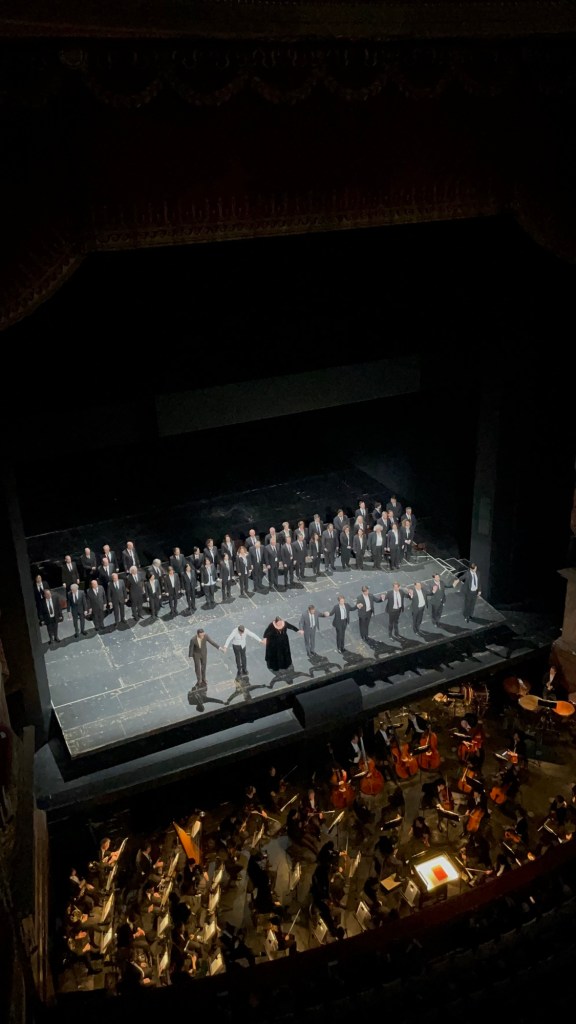
Article featured photo credits to Bayerische Staatsoper.
 Literally Left-handed
Leave a comment