
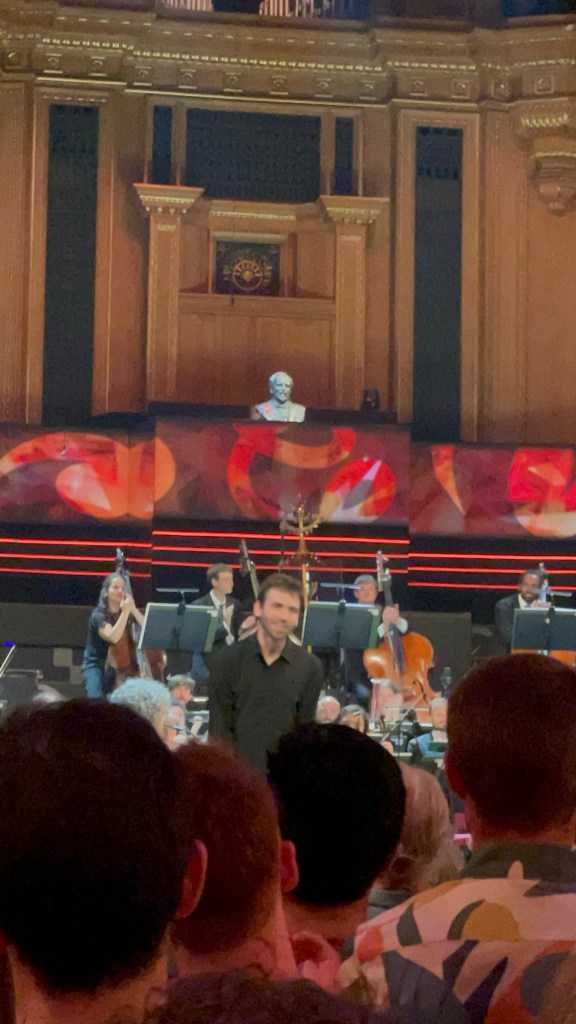
On Friday I finally had the chance to see Alexandre Kantorow, a pianist who is only gone on to scale higher and higher heights since his magnificent win at the 2019 Tchaikovsky Competition.
Unfortunately, I didn’t seem to be the only one to think that, because not only were the sitting tickets sold out, the standing arena of the Royal Albert Hall was also packed when I arrived. This unassuming young man without the larger-than-life personalities typical of celebrities has managed to gain a massive following in only a few years.
To warm up the audience, Maxim Emelyanychev and the Scottish Chamber Orchestra performed an entertaining rendition of Rameau’s Les Indes Galantes suite in which the thumping of a decorated sceptre and Maxim playing the drums during the famous movement “Les Sauvages” was involved. Looking around the packed Albert Hall, it is encouraging to see so many people flock to watch Baroque dances in this day and age. The performance also revealed Emelyanychev to be a creative and energetic personality eager to find interesting ways to dazzle the audience.
But of course the main event of the evening was Kantorow’s performance of Saint-Saëns’ Fifth Piano Concerto, a piece that is gaining popularity, and rightly so, for its virtuosity, catchy melodies and innovative use of harmonics make for very entertaining listening.
The music streamed from Kantorow’s fingertips as naturally and seamlessly as though there were no piano there. Kantorow’s playing was utterly devoid of pretension; not for once did he seem to draw attention to himself or his flawless virtuosity, even as the music was a showcase of brilliant fireworks and flashy harmonies. Surprisingly, it was this devotion to making good music that allowed him to draw out of the piano exquisite sounds and spin silky threads of melody. Everything was so well-placed it appeared to be conjured completely spontaneously, and therein lies this paradox, this tension that held the Albert Hall audience spellbound for the entire thirty minutes that Friday.
Kantorow is a natural storyteller, able to distill even the most complicated passage into its pure essence, allowing all to share in the joy of music. As he sat there, completely relaxed, and as I stood there in marvelous awe, I could feel his total pleasure in music, and I just thought how wonderful it is to share music, to enjoy it. At the root of it all, pleasure is why we make music, and Kantorow’s performance of Saint-Saëns’ Fifth Concerto reminded me of that with spellbinding conviction.
After much-deserved applause from a packed Hall, Kantorow delivered an arrangement of “Mon coeur s’ouvre à ta voix” from Saint-Saëns’ opera Samson et Delilah.
The second half opened with an interesting but slightly long-drawn premiere of Jay Capperauld’s Bruckner’s Skull, commissioned by the Scottish Chamber Orchestra. Of course, I was waiting for Beethoven’s Fifth Symphony which came after. Emelyanychev took a rather brisk tempo which was effective in showing the overall structure, and how all the motivic cells link together, but unfortunately lacked the power and force of tension contained in silences.
In my opinion, the choice of period instruments–natural horn and trumpet–didn’t bode well in the acoustics of the Hall, which can be rather unforgiving, but Emelyanychev certainly showed he was someone who was unafraid of thinking outside of the box with some of the interpretative decisions he made to make the music sound interesting.
As I listened I just thought how amazing it is that despite Beethoven’s Fifth being such a well-known piece, I am still at times surprised by the turns Beethoven takes in his music, defying all expectations and yet doing so with such conviction. Certainly he is a composer through whose music one can catch a glimpse of the man behind, and one never fails to be inspired by the spirit and force of will behind it, even after more than two and a half centuries.
Article photo credits to WQXR.
 Literally Left-handed
Leave a comment