
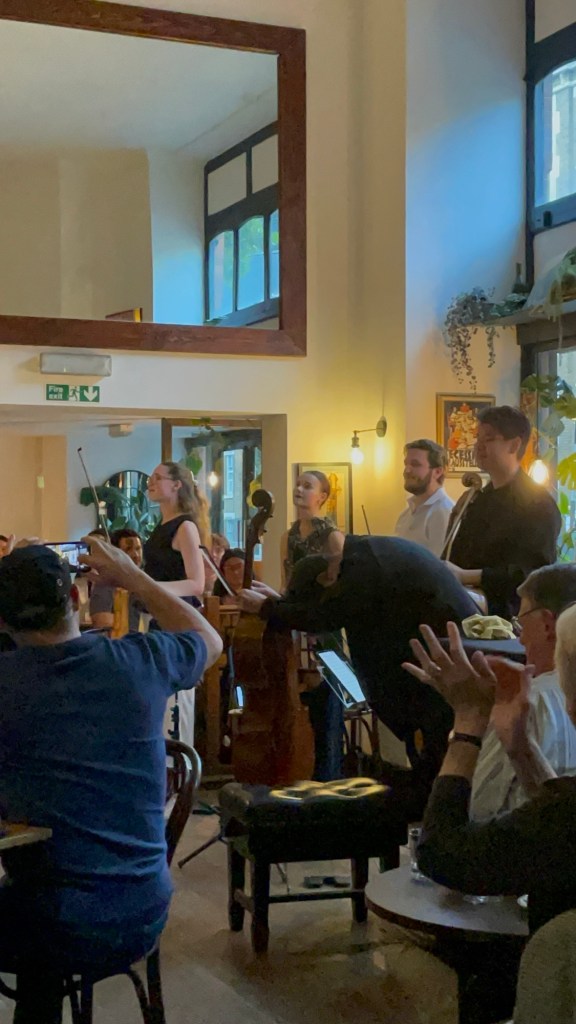
The Fidelio Collective made its successful debut yesterday evening at a packed Fidelio Café in Clerkenwell.
As commuters swarmed towards Farringdon station on a cool summer evening in London, I gingerly picked my way against the tide and ducked into Fidelio Café, bang in the centre of Clerkenwell Road commanding an open view on that bustling street. Already the Café was buzzing in anticipation of the evening’s concert ahead.
Fidelio Café, an idea conceived by Raffaello Morales just prior to COVID, has blossomed into a staple alternative venue for classical music in London, combining the quaintness of a café setting with high-quality music by world-class musicians from all around the globe. It even has its own homegrown Fidelio Orchestra that has outgrown its place of birth, performing symphonic concerts all over London. At the café, you occasionally get the side order of an ambulance passing by or catch an earful of street feud but that’s all part of the London package.
Giving a different space for classical music means offering a chance to hear classical music differently. The intimate space allows both performer and audience to be more relaxed, away from the solemness and severity of large concert halls that can sometimes put a chokehold on both parties.
A perfect opportunity to perform chamber music with different people, thought William Lui, founder of the Fidelio Collective, visualizing an ensemble made up of members of the Fidelio Orchestra that puts on regular chamber concerts at the café, hence there we were last night.

For its very first concert, the Collective had chosen a programme surrounding C major and the string quintet form which incorporates double cello: Boccherini’s String Quintet in C, nicknamed “Night Music in the Streets of Madrid” and Schubert’s sublime String Quintet.
A delightful programme that includes both playfulness and pathos, the evening opened with William and Gabriel playing their cellos like a guitar. Of course, unconventional spaces require adjustment not just from the audience but also from the performers, but the players settled into the “rhythm” of it in no time, and a surprise appearance of a tambourine brought out by William halfway through the piece brought the audience in on it as well. There was a real sense of communication between the five performers, but more importantly, they seemed to be having a lot of fun.
It was my first encounter with this chamber masterpiece of Schubert, and the Fidelio Collective gave a very convincing introduction to it. There was a clear collective vision of tonal colours which in Schubert’s music has deep and profound connotations as he traverses harmonies far and familiar. Some wonderful playing from Gabriel Francis-Dehqani in the second movement as the second cello reveals ghostly semiquavers rippling the peaceful surface of the recapitulated theme. Admittedly one would have wished for longer melodic lines to reveal the intensity of Schubert’s musical vision in the slower moments but this was made up for by the wonderful energy the Collective brought to such a demanding programme (and in a space that doesn’t allow much movement!). The Collective really brought out the Hungarian verve in the final movement as they built towards an exciting, bravura finale.
Congratulations to the Fidelio Collective on giving a debut concert of fine music and to William for doing the hard work of putting together a diverse and exciting programme performed by a group of wonderful young musicians.
The Fidelio Collective will be back at Fidelio Café on 16 September with Messiaen’s “Quartet for the End of Time” and I am sure to be there.
Article featured photo credits to Fidelio Café.
Programme:
Luigi Boccherini String Quintet in C major, op. 30 no. 6 “Night Music of the Streets of Madrid”
Franz Schubert String Quintet in C, D. 956
Fidelio Collective Performers:
Kayla Nicol violin
Yeva Volkava violin
Connor Quigley viola
William Lui cello
Gabriel Francis-Dehqani cello
 Literally Left-handed
Leave a comment