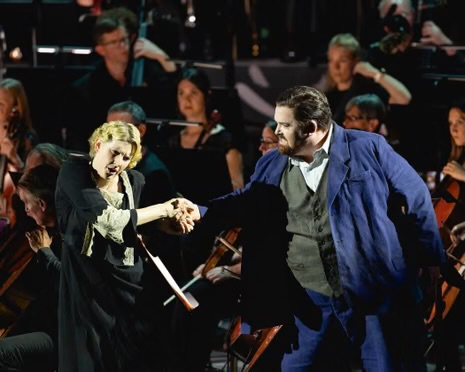
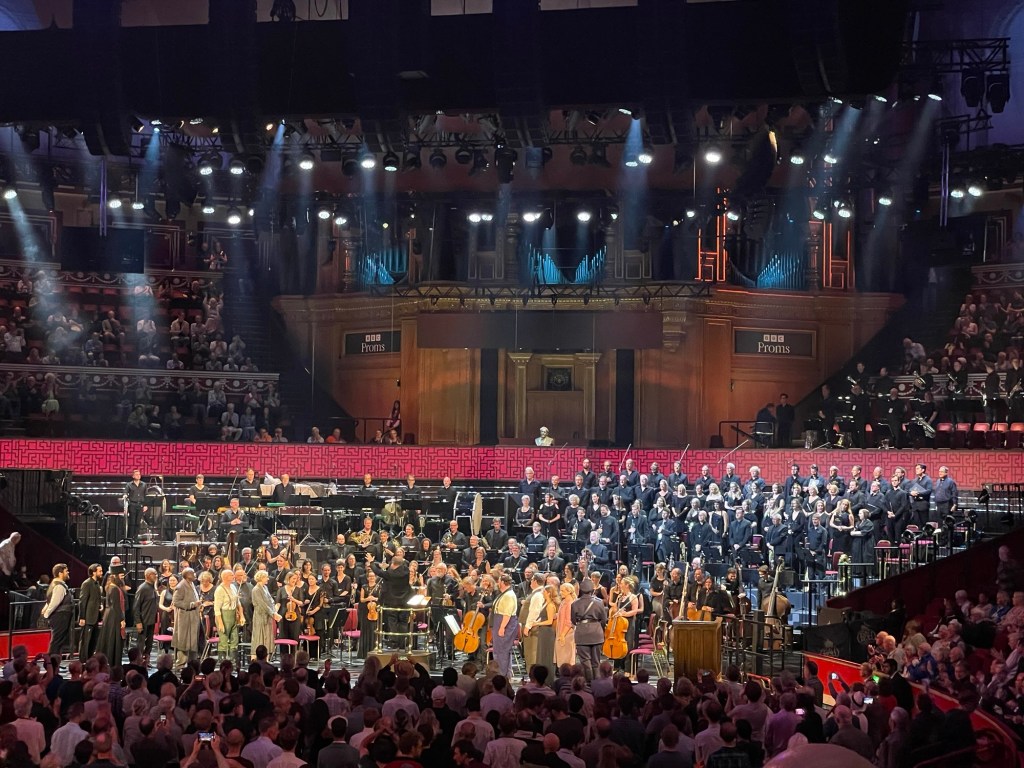
On Monday evening I found myself on the train once again, swimming against the current of commuters towards the Royal Albert Hall for the BBC Proms. This time the BBC Philharmonic, BBC Singers and English National Opera joined forces under John Storgårds’ baton to present Shostakovich’s grand operatic tragedy Lady Macbeth of Mtsensk, celebrating the 50th anniversary of this great Soviet composer’s death. It was an enormous production that used up every last inch of the Albert Hall’s colossal stage.
Now I must say that concert was not on my list of concerts to go to for the Proms, but my good friend was assistant conductor for the BBC Philharmonic so I wanted to go support him.
I’d always felt a bit “iffy” about English translations of operas, but I’m glad I went to this one, because I was proven completely wrong.

If anything, the removal of the language barrier made the opera much more accessible. Enough puritan speak about how translation ruins the beauty and the flow of the original; as an operatic layman (and I’m sure most people in the Albert Hall that night were too) what I care most about is how engaging the opera is, and certainly the lewd jokes and vulgar actions were much funnier when spoken in a language we understood. Otherwise who knew where to laugh? And collective laughter is a powerful ingredient for a successful dramatic experience.
And lewd the opera most definitely was. Despite it being a great tragedy, there were many moments of absurdity and ridiculousness, revealing the senselessness of a seemingly noble system: a woman who married rich and supposedly had nothing to complain about apart from her husband’s impotence finds herself so bored she would willingly fall in love with a man she knows to be an abuser of women and a serial womanizer and actively pursue marriage with him; a man raves about lusting after his daughter-in-law even though it was he who demanded her to be faithful to his own son; a priest who married a couple while not even trying to hide his own lust for the bride. Yes, there was a whole lot of lust involved and not a lot of morals. Very difficult to categorize or empathize with. Even though I had read the synopsis beforehand, the turns the plot took still surprised me.
A perfect story for Shostakovich to turn into an opera. Indeed, as the opera unfolded before me, I became more and more fascinated by the man behind the music. With his music, Shostakovich was able to make the opera very exciting and dramatic, almost like a movie. In moments of high seriousness his music turned it into parody, and I marvelled at the way he was able to create pastiches of many different genres while very clearly maintaining his own voice.
The semi-staged performance was still highly dramatic, with efficient choreography and use of the stage. Unfortunately, the grand scale of the performance—the ENO band had to use the choir stalls—meant the singers were quite often drowned out, especially when Shostakovich’s music is so cacophonous and chaotic. Still, Nicky Spence as Sergey, with his very powerful voice and clear diction, definitely stood out for me. As did Anna Majeska as the heroine Katerina, who embodied the role so well.
For me, however, the opera dragged on for too long (more than 2 and a half hours long). Since it is an adaptation of a novel, the story stretched on quite a bit, losing its conciseness and dramatic intensity, as well as my attention somewhere along the second half. Yes, I know it’s nowhere near as long as a Wagner opera, but again, I’m just an operatic layman.
Article featured image credits to the Guardian.
 Literally Left-handed
Leave a comment