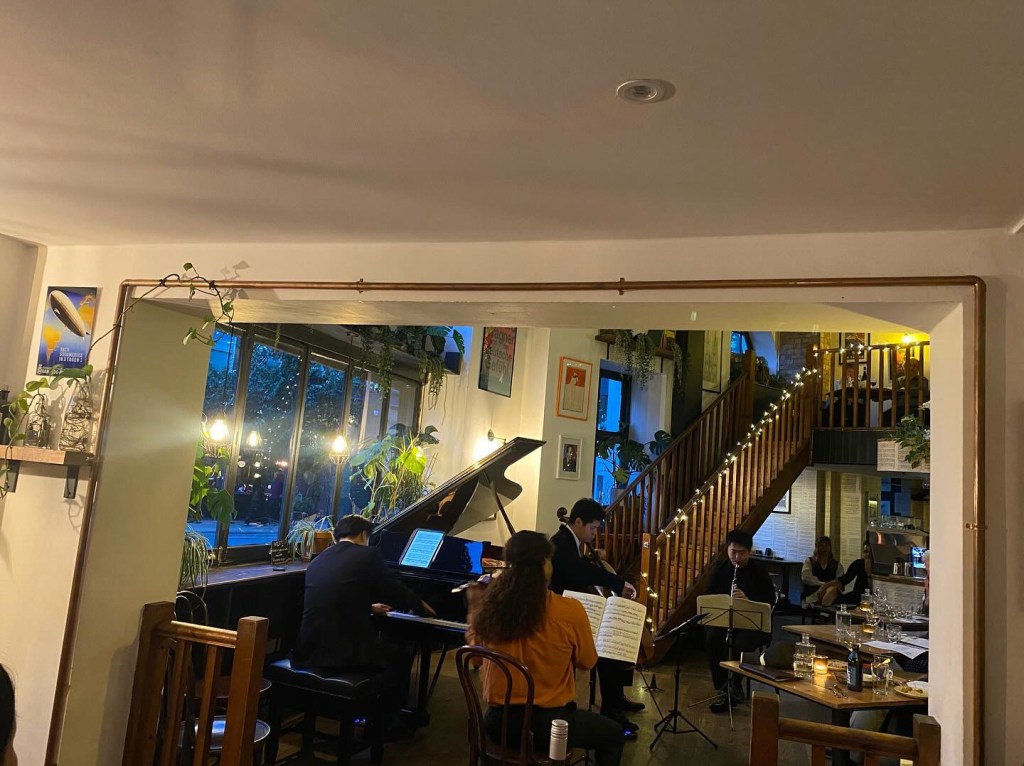
Last Tuesday I returned to Fidelio Café to perform Messiaen’s “Quartet for the End of Time” with the Fidelio Collective. Once again an intense experience with the music turned into a beautiful evening meeting wonderful new people and sharing great food with friends.
Three of the four in the quartet had performed the “End of Time” Quartet last year at the Bloomsbury Festival. Tiago the violinist was a new addition who stepped in with two weeks’ notice after our original violinist Violetta injured herself. He did an impressive job learning such a big piece in such a short period of time.
Coming back to this crazy piece, Messiaen somehow feels…easier? Without detracting from the gravity of its musical substance, my body has somehow absorbed Messiaen’s musical language, and his exotic scales and harmonies no longer feel as confusing. Even in parts where the chords are extra dense, I could feel my fingers finding the way on their own. Of course, I still needed to practise—and certain passages can be finger twisters—I didn’t have to fake it like I did the first time.
Lately I’ve put more emphasis into finger work. In the past I’ve relied more on arm movement and as a result my fast passages have suffered. But lately I’ve tried to train my fingers to work more and be more nimble, and have found many passages I previously deemed impossible actually playable.
This was especially the case with the deceptively difficult fifth and eighth movement, the two “Lounges de Jesus”, where the music is so slow time seems to stop and the melody stretches into infinity. In the fifth movement, the piano accompanies a never-ending cello melody, playing semiquaver chords outlining the harmony—at 44 semiquavers per minute! To play so slow requires complete, intense focus, while being relaxed enough to produce a warm sound at a consistent pace. The final movement is worse; I play an extremely short dotted figuration at an extremely slow speed (36 quavers per minute!), so it sounds like an unwavering heartbeat. As the violin melody soars higher into the heavens and the music increases in intensity I must retain the same rhythm, otherwise everything falls apart, and that is an incredibly difficult thing to do; to restrain oneself in order to create music of great religious ecstasy. The worst thing is that the effect of the entire Quartet hinges on this final movement! It is what, after all the bombastic chaos of the preceding movement, will leave the audience breathless and feeling transformed by the experience.
No pressure!
Previously I used my whole upper body rather than just the fingers, and the physical movement created inconsistency in touch as well as created tension in my shoulders and neck. Now, I’m able to sit more still, channeling the energy through the fingertips, which definitely helped.
The four of us got together for the first time three days before the concert. No practice rooms were available at the school so we had to resort to the room next to the school bar. Unfortunately it was Freshers week and much of our rehearsal was spent with DJ music booming just next door. Still, Tiago had come super well prepared despite the short notice (he had two weeks to learn the entire piece) we breezed through the piece.
On average we spent three hours a day rehearsing leading up to the performance. I was fortunate on two counts: firstly, the Messiaen quartet is not a piano-heavy piece; unlike the other instruments, I am not given a solo movement and most of the time I’m just there to provide accompaniment or add to the texture. Secondly, apart from certain parts in the tutti movements and especially the sixth movement where we all play in unison for an entire movement where different bars have different numbers of beats, the music isn’t too difficult to put together, mostly relying on the soloistic capabilities of the instruments (movement 3 for solo clarinet is a canonic piece for that instrument). However, being unaccustomed to playing contemporary music, counting all the irregular metres in movement six still proved to be quite a challenge, and I’m afraid I didn’t completely nail it in performance either.
On performance day, we had two hours of rehearsal and then it was showtime. I wrote an introductory speech to the piece giving an account of its brief history and context and a little bit about what does piece is meant to convey.
Basically, coming to this Quartet a second time, I now see that Messiaen had in mind something much more specific. Although the Quartet is an early example of a system he would develop much more in later masterpieces like the Vingt Regards sur l’enfant Jesus and which he articulates in his “Methods of Composition”, it already contains many important features.
In attempting to depict something as vague and abstract as the End of Time, Messiaen is actually very specific. He sticks faithfully to the lines in the Book of Revelation which inspired the Quartet (the Quartet is dedicated to the angel who announces the End of Time in the Bible’s Book of Revelation, hence the title), noting clearly details such as rainbows and rocks and the Angel himself and translating all of them into music. Birdsong features prominently, since Messiaen regarded birds as heaven’s messengers, and being a keen ornithologist, Messiaen actually took pains to listen carefully to birds and transcribe their “song” onto staves, several octaves down! So yes, Messiaen was oddly systematic to the point of eccentric in portraying a topic so vast and vague.
In this obsession with finding a system I find Messiaen similar to Scriabin, who also developed his own extremely complicated harmonic system to express his theosophical beliefs.
The other thing is Messiaen’s extreme obstinacy. I read that while he was taken prisoner by the Germans (and it was in a German prison camp that the Quartet for the End of Time was conceived of and composed) Messiaen only took with him a couple of scores and the Bible. His stubbornness is revealed not only in his unwavering faith, but also in his insistence that his music expresses nothing but what is written in the Bible. Coming back to this piece after a year of personal growth, I find this stubbornness, loyalty, faith or whatever you’d like to call it, very admirable. It’s more Messiaen’s principle that is inspiring rather than the content itself. In a world where so much is changing, witnessing such immovable faith is—pardon the pun—very moving.
I’m not saying this as if our world is much more chaotic than Messiaen’s; I cannot possibly imagine how much the world was in flux back in 1941, especially as a Frenchman in a German prison war camp. That’s why his obstinacy, a principle passed down to me through his music, is that much more moving.
I was worried how the piece would be received by the audience at Fidelio Café given how jarring and dissonant it could be at times. It also requires the whole ensemble to play at fortississimo at times for an extended period which, in that small space and with that massive Steinway, could be quite a lot.
But we received overwhelming praise. We even got a few standing ovations. Making the rounds and talking to the entire cafe afterwards, I realized many who bought tickets already knew about the Quartet, mostly through recordings. Many told us experiencing it live was really something else. Some even said it was one of the best concert experiences they’ve ever had! I, of course, am obliged to take such compliments with a pinch of salt.
Nevertheless, I can’t help feeling that this is all Messiaen’s doing. His music is written in such a way that the performer is merely a vessel revealing the full glory of his music. And according to his own beliefs, his music is only his way of expressing the full glory of God.
When audience members told me they felt they’d come through a long journey, I must confess I did the same, with as much marvel and wonderment at the genius of Messiaen as they did.
I wonder when I will play the Quartet for the End of Time again, and I wonder what I will feel then.
Post featured photo by Roksana Dabkowska.

 Literally Left-handed
Leave a comment