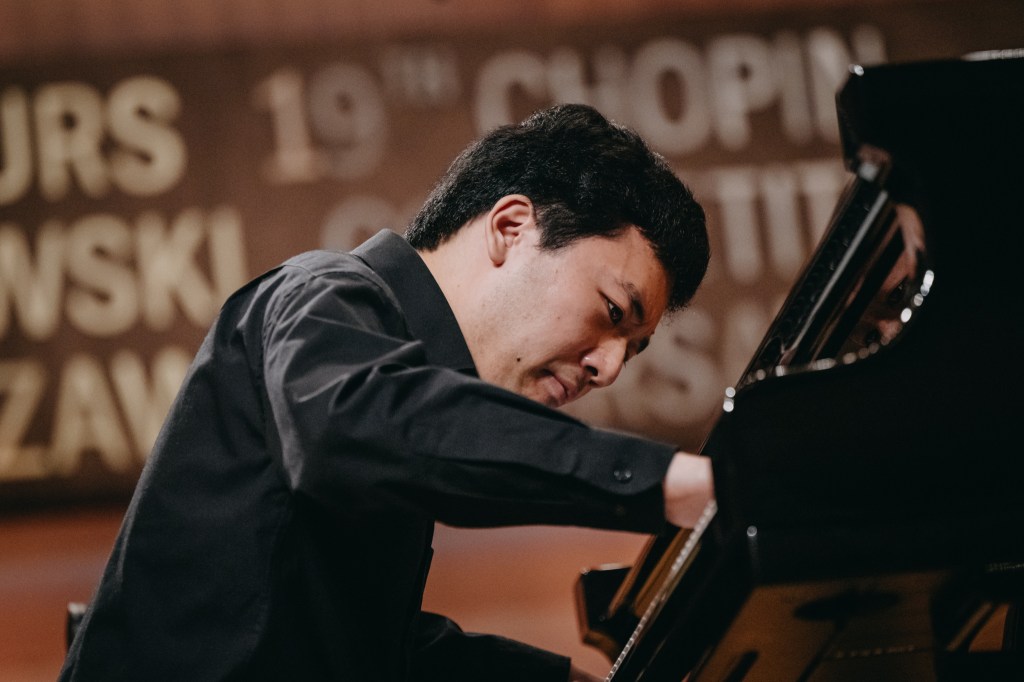
The Chopin International Piano Competition is the most prestigious competition for a pianist. Each year it attracts the world’s most stellar pianists and is streamed by millions worldwide, all watching with bated breaths to witness history as the next star in classical music is born.
Before he left for Warsaw, I caught up with Yuanfan Yang, one of the competitors this year, to talk about preparation for the competition, playing Chopin’s music and how improvisation influenced him as a performer.
What started as an interview quickly turned into an extemporization on the virtues of improvisation and being in the moment in performance (pun intended).
What is the significance of the Chopin Competition for you?
Everybody has heard of this competition which has been going on for nearly a century. If you look at the list of past participants and winners, it reads like a “Who’s Who” of the piano world; some of the greatest artists were produced from this competition.
I was in the last edition of the Competition. I got to the first stage, and that I already consider a huge success.
The focus of the competition is solely on Chopin, which makes it very unique, but it’s ironic that being able to play Chopin well can reveal so much about who you are as a musician. You have to be a really sincere and high-level musician to play his music well and chances are, if you can play his music well, you’ll play music by other composers very well too.

How is preparing for the Chopin Competition different from preparing for other competitions?
It’s a very unique feeling to really zone in and explore one composer. The more I did this, the more I started to understand why other people specialize in certain composers or music from a certain period. It takes over your entire world of thinking and how you respond to music, and still there is more to explore in this world.
Of course, in Chopin’s music one can trace a line to other composers. We know that Chopin loved Bach. He loved composers who were already dead. He was not so keen on people who were alive in his age at the time. And so a certain kind of classicism permeates his music.
What informed your repertoire choices for this year’s Chopin Competition?
I wanted to find a few pieces that were a little less heard or played, but still of really high quality. For example, I chose Chopin’s Variations on “Là ci darem la mano” which he wrote when he was 17 and which effectively launched his career. It is representative of an early, virtuosic style closer to Liszt, something he tried to break away from later on as he searched for more emotional depth in his music.
Another piece is the E flat major Nocturne, op. 9 no. 2. It is of course a very well-known piece, but you may not know the version with authentic variants which I will be playing in the Second Round. It is in the new Edition Peters score, the series editor of whom is John Rink. That particular piece in the collection, however, was edited by one Christophe Grabowski.
In the Nocturne with alternative variants, you get a lot of ossias–alternative ornamental passages–all very improvisatory and florid, but every single note actually written by Chopin, not necessarily during publication, but when he wrote into student copies or suggested alternative versions. That shows you just how malleable and free people from the Romantic Era thought about music.
There is this sense of real improvised quality in the music, and from this edition you could really see that composers would change their minds about their own compositions. I understand that much more now, especially as a composer myself. A lot of decisions I make are in the spur of the moment, which could easily change in six months’ time.
The reason we have so many editions of Chopin’s music is because he changed his mind often, sending off different scores to different publishers. There is a theory that Chopin himself might not have known what exactly he wanted, but that’s what makes his music so interesting; the fact that it’s not set in stone.
How do you manage your practice before this competition? Do you try to be as secure as possible?
One of the things I often do in concerts is improvise on themes and styles that I take from the audience, creating a brand new piece of music on the spot. That kind of mentality applies even when you’re playing music written by other people, because you need to feel as if you’re creating something in the moment.
You’re not just here to present something that you’ve prepared in the practice room. If you do that, it will feel a little bit stilted, and people will hear it. It’s too forensic and scientific a way of performing. When I watch the great pianists perform, I feel moved and ultimately touched, which I think is the highest level of being we can feel as an audience member. That is the highest expression of artistry and music making. I don’t go to a concert with my nose buried in a score.
Have you encountered difficulties while preparing for the Chopin Competition? How did you deal with them?
Sometimes going away from the piano helps, sometimes things might sort themselves out. Getting distracted and doing something else could also help. Sometimes you don’t find a solution. Sometimes you find a solution after everything’s happened.
We think that a lot of piano playing and this kind of competition preparation is physical, but actually so much of it is mental. How you think mentally can affect how you play or practice something. Sometimes I don’t really understand how these things work, and it’s really fascinating.
I think that’s what’s so magical about piano playing; sometimes science can’t solve it, despite us trying to be logical about it. I often surprise myself too.

Given that Chopin himself often came up with different ways to improvise over his own music, do you think we should be faithful to what he wrote or try to look for spontaneity in our interpretations of his music?
The more I compose and the older I get, the more I realize that every note on the page is just a means to an end. It’s not the literal thing. It’s a signal for you to do something, a clue to something that can’t be notated.
I noticed this when writing my own music; there are so many fluctuations you can’t actually notate: dynamics, for example. Look at ppp, mp, mf. Sometimes I want something in between for just two notes, then something slightly different for the next notes. These things come with interpretation, and that’s when you realize how open-ended it all is.
The key is to get something close to what the composer wanted, but also have your own interpretation. Ultimately it comes down to this: does it move you? Does it convince you? Do you feel something when you listen to it? If the answer is yes, then your work is done.
It’s always useful to study the score, manuscripts and letters, but those are all means to an end. Once the music has been created, it belongs to something else–it belongs to you as the listener.
Great interpreters bring their own personality to the music, or find something inside that’s true to both themselves and to Chopin.
Of course, it’s much easier said than done. You can spend a lifetime trying to find what works for you, and it might be very different for someone else. That’s what makes life interesting.

How does improvising influence your performance?
Well, the trick is to play as if you were improvising. On stage, that’s the most natural way of music-making.
I often think back to filmmaking. I believe Daniel Day-Lewis is one of the greatest actors in the world. He memorizes every line, but everything sounds as if he’s coming up with it on the spot. You can’t even tell it’s him when he switches between roles. On stage, like acting, you can’t think about the next note–you have to completely embody the music so everything comes out naturally. That’s what connects acting and music: improvisation and total presence.
What is difficult about Chopin’s music for you?
From a superficial point of view, the technical aspects of his music are very difficult. Everything is so exposed. In Schumann or Rachmaninoff, you can sometimes hide behind the notes, but in Chopin, everything is transparent. The etudes, for example, are relentless–you don’t get a chance to breathe, unlike in Liszt’s.
Chopin mazurkas can often be challenging. The mazurkas are all about natural rhythm. A teacher said to me: “you either understand them or you don’t”, which is true. You can think about where the beats go, but the real question is how Chopin emphasizes them. Do you delay the emphasis? By how much? If you do it here, should you do it there? The subtleties are what you need to figure out.
You also need to be in the right state of mind on stage. In Chopin, so much spontaneity is needed, that’s why it’s not just about delivering a performance from start to finish, but also about being inspired while doing it.

You’ve done a lot of competitions. Do you think they are beneficial and necessary?
Yes, for a variety of reasons.
I’ve met wonderful people and lifelong friends through competitions. You wouldn’t meet them if you stayed home practising or only gave concerts.
You also get to travel. For example, doing the Sydney Competition was a great excuse for me to go to Australia. I got to the Finals and played twice with the Sydney Symphony Orchestra at the Sydney Opera House. These opportunities are incredible.
Jury feedback in competitions can also be valuable. Some people find it useless, but it depends on how you approach it. A good juror distills points quickly for you to think about. Sometimes one opinion is just that, but if four or five people say the same thing about your playing , you know there might be some truth to it. These are perspectives you might not get from your regular professor.
The worst thing is only being willing to stick to the opinion of one teacher but absolutely refusing to listen to anyone else’s advice or opinion. A solid base is important, but hearing other perspectives is also crucial, and competitions can help with that.
Finally, competitions can be fun too. Sitting with fellow like-minded competitors for hours outside practice rooms talking, eating and drinking–it’s wonderful. The convivial spirit is magical.
What do you hope to get out of participating in the Chopin Competition?
I have my own artistic imprint and vision and this is a wonderful platform to share it. If I can go on stage and create something on the spot that represents me, fulfilling myself honestly, that is an achievement in itself.
Article featured photo credits to Chopin International Piano Competition.
 Literally Left-handed
Leave a comment