
I had a conversation with Aïda Lahlou, whose unique and individual career in classical music is reflected not only in her debut album, Mirrors and Echoes, but also in the way she views art and being an artist.
A conversation about her album quickly turned into an in-depth conversation where Aïda laid bare some of her hot takes on what it means to be a classical musician.
N. B. This article was published on 18th October 2025. The Green Party conference referred to happened on 4 October 2025.
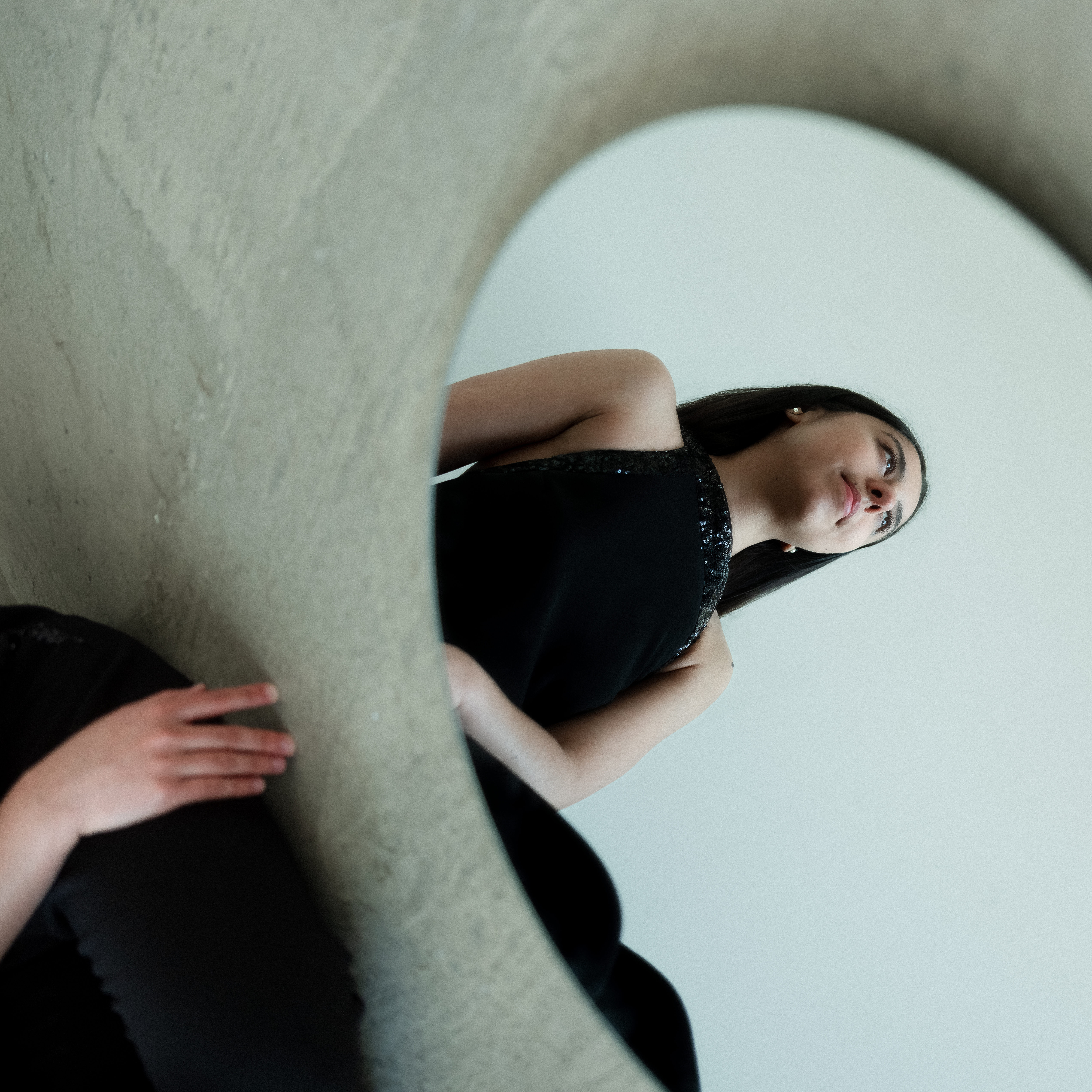
Let’s start with your album, Mirrors and Echoes. Can you tell me a little bit about the concept behind this album?
In a nutshell, it’s an album that has different themes. One of them is nature. Others might be spirituality, memory, and introspection. These are the main themes, and then how it works is that, from start to finish, you have a conductive thread. There are logical links from piece to piece, and musical ‘echoes’ between works in different places within the programme. The programme also roughly maps onto a 24 hour day, from dawn to dawn, with specific ambiances associated with different times.
A lot of albums are constructed in a sort of balanced way in which you have maybe a large piece or two and then some fillers. It’s not the case here. Even the so‑called large piece–Ravel’s Miroirs, made up of five pieces–is broken up into its separate movements. So all the pieces here are on the same footing.
And how did you come up with this concept?
In general, the ideas I have for my various projects come from consuming art, seeing what’s happening around me, and understanding what the world needs. There are things I like, and these form the inspiration for new programmes or formats. The themes surrounding this album have always been interests of mine: psychology, different cultures, nature, and what makes us good humans at the end of the day — being at peace with oneself. When you are at peace with yourself then you can be at peace with the rest of the world and the natural world. These themes are very important to me and have always been my preoccupations.
In your album, apart from the pieces that a lot of fans of classical music would know, you also include some pieces from other cultures, such as Armenia and Andalucia. Do you make a point of including these pieces in your album? Or was it because of your album’s concept that you decided to search for these pieces?
I think a bit of both. I’m not necessarily committed to going wild in terms of programming. My rule is to, no matter what, only play pieces that I love, regardless of whether or not they are famous. I’m not desperate to look for exotic pieces just for the sake of it. But for this particular album and what I was trying to do, the idea of discovery was so important that I think having pieces that were to a certain extent obscure was important artistically.
A lot of people try to be different and it doesn’t necessarily yield anything nice.
As a listening experience it is very different to hear a piece you’ve never heard versus hearing a piece you’ve known. Even with the more famous composers included in the album such as Beethoven and Brahms, I chose from their oeuvre pieces not often heard, such as Beethoven’s Polonaise and Brahms’ motets to make the point that there is plenty to discover and explore, even with the more famous composers.
The way you programme your album and recitals is considered a deviation from the standard classical piano recital programme. Do you think we’re a little bit stuck with our ways of thinking about what classical music should be and how it should be performed?
I think in general, the more creativity the better. However, I would caution against just trying something different for the sake of being different because then it becomes dishonest and kind of cliché. A lot of people try to be different and it doesn’t necessarily yield anything nice.
I don’t think there’s anything wrong with sticking with the tried and true formula. The classical, balanced recital is fine. But it’s important to inject some sort of individuality and personality into your programme — even if you’re playing a traditionally programmed recital. Why have you chosen the pieces? Why should you be the one playing them? There is room to be creative even within these programmes.
As a consumer of classical music, I’m also very interested in new formats — and all the better if the format actually serves to deliver a message. I don’t think my format would have worked as well if I was trying to deliver a different message. But for what I was trying to do, namely disorientating people, embarking them on a voyage of discovery, I think the fact that I didn’t choose a standard programming format was more effective. That way, the medium was the message.
You can look at artists like Volodos, for example, who did an all-Schubert recital. He included a couple of sonatas and then some smaller pieces, which could be considered a fairly standard approach. But the artistry comes in the choice of smaller pieces. He’s really particular about which smaller pieces from Schubert he chooses, and then how he weaves them together, sometimes even creating a new ‘unit’ out of two pieces with different opus numbers, composed years apart [Minuet in C-Sharp Minor D.600 and Trio in E major, D.610]. He just coupled them together like a Minuet and Trio. And it worked. That kind of vision and visionary mindset I found really interesting. The rest of the album is made up of works from very different periods of Schubert’s short life.
The result is a portrait of Schubert that only Volodos could really reveal to you. The way that Volodos programmes delivers an extremely personal, extremely particular view into Schubert’s world, which I found very compelling, even though it could be considered to be a more ‘conventional’ recital.
So there is enormous scope even in classically programmed recitals to be individual. But you really have to dig deep. The question is: how deep are you willing to go as an artist?
This is a crowded industry, in order to be noticed you have to be individual.
Yet to think individually as an artist is not how conservatoires prepare students for. There’s a feeling that conservatoire training is to prepare you for competitions, which are nowadays gateways to a performing career, and competitions often require a certain balanced programme which is almost a formula: a Baroque piece, a Classical Sonata, a large-scale Romantic piece and something from the 20th century. A sprinkle of etudes and a handful of concerti along the way. The cycle continues and musicians are trained not to think individually but to comply with certain things. Eventually individualism gets eroded, doesn’t it?
Definitely. There’s also the question of time. Coming up with an honest, truthful programme that fits you and that people enjoy listening to takes time. Exploring repertoire takes time. If you’re already busy with three Chopin Etudes, one or two Beethoven Sonatas, two concertos, and five competitions to prepare for, you’re not going to have the time.
You’re prioritising something that is not necessarily the most artistically interesting result. It’s a shame that a lot of people who I sincerely believe have a lot to say musically don’t allow themselves to explore in this way because they feel they can’t drop off the race of competitions.
From a purely commercial sense, the advice I got was: this is a crowded industry, in order to be noticed you have to be individual. If you do the same thing as everyone else, that means that, even if you play very well, you are replaceable.
Because of that, I thought, right, okay, if I want to be a pianist long term, if I’m really serious about this career and making it work, strategically it’s probably better to use this early period in my career to get noticed by doing something different, something that only I can do. Then hopefully that unlocks a platform to do other, more conventional stuff, as well, once I’ve earned the attention of an audience.
Aside from the commercial aspect, I also personally get more excited by the process of finding my own voice. It’s a fun journey to go on, albeit a hard one.
The flip side is that I am missing out on things like competitions, but I made peace with that. I have tried competitions. I have submitted applications. Sometimes I do really well — I’ve got over 20 prizes from competitions. I know how it works. But it’s very random. And it’s a lot of effort.
In my opinion, artists have some responsibility towards the world around them
I then thought: I could try for five years and risk getting nothing out of it. Or I can try and do something artistically compelling and different, and establish my artistic brand. Hopefully that sets the scene for more work because people start being interested and you’re not lost in the magma of competitions.
My strength as a performer is storytelling. Competitions don’t allow you to do that. So I was probably not going to do as well in competitions as people whose strength is in competitions. However, I can compete in another way by doing a project that is entirely based on storytelling.
Of course, you choosing what to do with your career has shaped how you see music and the role of the artist, which is probably different from how other classical musicians see it. What do you think the role of the artist in society is nowadays?
This is a very personal question and people may disagree. In my opinion, artists have some responsibility towards the world around them because we already have so much privilege by being exposed to the best ideas of the world’s best thinkers, the best arts. We’ve had the training, the exposure. We also have quite a lot of cultural capital and social capital. Especially classical musicians — we’re often invited to really fancy receptions or we play at posh events. We are around quite powerful people. This is a privileged position.
Because of that, we are expected to create things, and I think whatever we create should aim to make the world a better place. There are lots of problems in the world. A lot of artists want to help. In some cases, they treat the symptoms but not the root cause.
For example, they might create a programme based on female composers. But then that’s it. They don’t engage more meaningfully beyond that. There’s a whole system underpinning why women composers are not represented enough. If you dig deep enough you basically become an activist.
If you manage and succeed so that two or three female composers are more listened to, it doesn’t solve sexism. It doesn’t solve patriarchy. It doesn’t solve power domination of one group over another.
Aside from what we do artistically, it’s important to think of ourselves as full citizens and take advantage of all the tools we have — politically, socially.
So one must get involved in extra-musical things to be a total artist.
Yes. I don’t believe in distinctions. I think art is part of the world and there’s no real separation. The idea that art is separate isn’t true. It’s a product of the world we live in. It has the power to influence the rest of the world and vice versa.
That speaks a lot about your artistic mission and the concepts behind your projects. Do you have any other projects coming up?
Yes, I’m actually hosting an event at the Green Party Conference this Saturday [4th October 2025]. That’s the next priority. I’m also starting my new concert series — we’ve had two concerts so far.
Again, that’s something I’m trying to do partly to better the music industry because there are a lot of concert series out there that are a bit exploitative to musicians. I want to play my part in changing that by paying musicians fairly and at the same time provide high-level classical music for free to people around Oxford, and help out independent businesses by bringing traffic to their cafes and restaurants. That way, music is genuinely a force for good in the community rather than a means of exploitation.
Decide: if you had the power to do anything, what would it be? Then reverse-engineer it.
Finally, if you were given a chance to give advice to a young aspiring pianist, what would you say?
Try to think for yourself. It’s super difficult, but try as much as you can. Instead of going into the usual stuff that people do — competitions, etc. — decide: if you had the power to do anything, what would it be? Then reverse-engineer it.
If your aim is to release five albums, become an expert in a particular composer or musical aspect, or create a social movement that changes the way musicians are treated — don’t wait for your teachers or anyone to say ‘you’re ready’ or ‘we’re going to support you in this.’ Make a plan, stick to it, and do it. You’re more capable than you think.
Mirrors and Echoes by Aïda Lahlou is available for streaming on all platforms.
All photos credits to Ben Reason.
 Literally Left-handed
Leave a comment