
In the third movement of Mozart’s final piano concerto, he quotes a popular children’s song, Longing for Spring, using it as his rondo theme. Quite a fitting theme for yesterday’s programme with the Philharmonia Orchestra, since after much back and forth I have decided that spring had indeed finally arrived in London. A bold statement to make in the land of fickle weather, but seeing people crawling about at Southbank, lounging under the sun with pints in hand, I am finally prepared to let a little hope blossom within me.
And so it was with a fairly light heart that I took my seat in the sparsely packed Royal Festival Hall, awaiting the Philharmonia Orchestra but most importantly, Mao Fujita.
I first heard Mao Fujita live last year when he did the complete cycle of Mozart Sonatas at the Wigmore Hall. It was one of the most memorable concerts I have attended and I couldn’t wait to hear him again. Indeed, he did not disappoint this time, taking on Mozart’s Piano Concerto in No. 27 in B flat with the Philharmonia Orchestra and young Lithuanian conductor Giedrė Šlekytė.
The opener was a rather tame and polite performance of Kodaly’s Dances of Galánta, whose energy didn’t seem to take off until the last few minutes. I wasn’t much taken by it and neither, it seemed, did the rest of the hall.
Mao didn’t make us wait long. Once the piano was ready and the small band of orchestra members settled, he timidly trotted onto the stage, dressed simply in his now iconic oversized black shirt.
How shall I describe Mao’s playing? Many ideas came to my mind as I sat there, completely captivated by the sound his hands were caressing out of the keyboard.
Yes, caressing, for his hands seemed flexible like rubber, changing shape as they rolled up and down the keyboard, always staying glued to the keyboard. Yet the sound he drew out of the soundboard of the piano was extremely clear, without a hint of limpness the position of his hands seemed to suggest. In fact, with his unique technique he produced such a delicate sound as I had never heard before.
The image of a bubble comes to my mind when trying to describe this sound. So rounded, so perfect, yet so delicate and fragile, easily popped by the slightest pressure. And there were moments when the Philharmonia Orchestra simply couldn’t handle the delicacy of Mao’s sound. Only he alone could conjure this sound, and only he alone could handle it. Its delicacy was so precious, one could only watch in amazement as Mao played around with this delicate bubble he had created with his equally delicate hands, rolling it this way and that in the beautiful soundworld he had created, a soundworld not imposing or authoritative but generously drawing you in, sharing with you the feeling of freedom and joy that did not have to pronounce itself to the world.
Mao created a half-hour long moment in which freedom and perfection came together in harmony.
And what of Mozart? Yes, it was totally Mozart, without any Romantic inflections or inappropriate rubato, but what we witnessed was Mao playing in the bubble Mozart had created, showing us the wonders and imagination Mozart’s world allows and even encourages. This was not the pristine, authoritative performance of an Uchida or a Barenboim, but that of a child who nevertheless has complete mature control of the keyboard and access to all its possibilities playing Mozart. In that, Mao has found a unique style for himself.
Forgive me for waxing lyrical about this young man’s performance, but it is special to me because it shows potential, imagination and curiosity towards music that many view as profound and requiring mature understanding. There is a reason Mao Fujita is gaining popularity nowadays and I think it’s because of his very unique attitude towards music, which shows through in his playing. His sound seems to radiate positivity, freedom and possibility. Perhaps that’s also why his Mozart performances are so special.
For encore he offered up a beautiful performance of what I strongly suspect to be a Prelude of Yashiro’s, a composer whose complete Preludes feature in Mao’s new album with Sony Classical.
Mao to thunderous applause after his intimate Mozart.
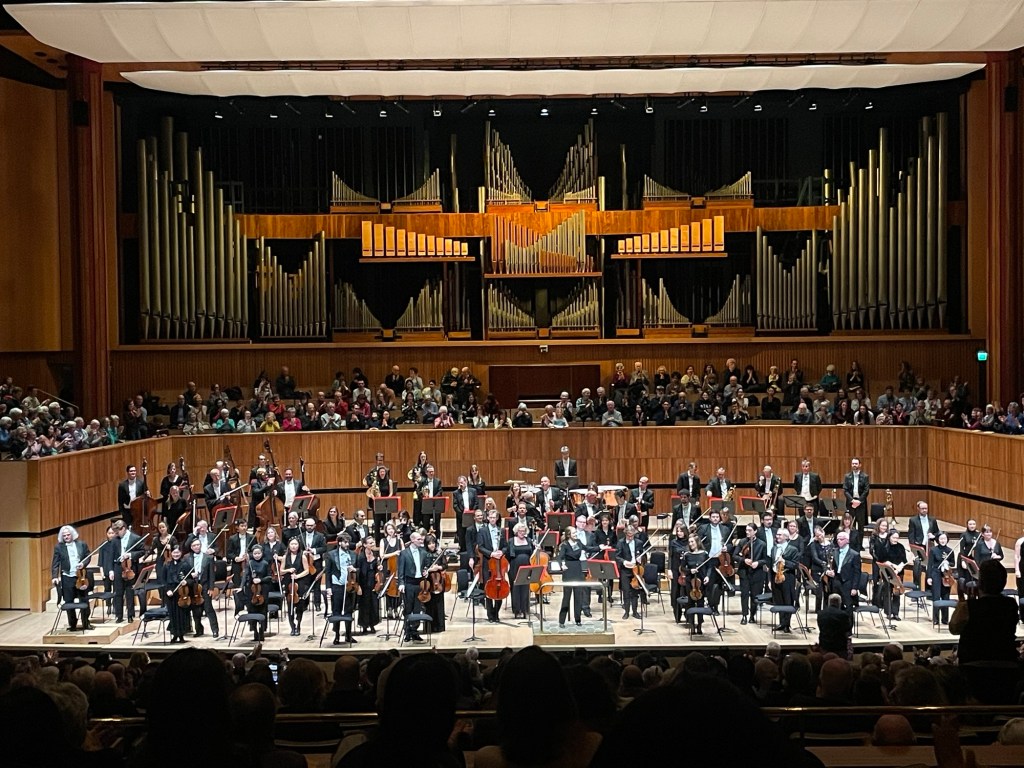
Brahms’ First Symphony followed after the interval, which saw Giedrė commandeering a much larger Philharmonia Orchestra than in the Mozart (much younger than normal too, it seemed; I spotted a few friends and colleagues among the orchestra). This seemed much more up her lane than the Mozart, and she brought with her a relentless drive and energy to this towering giant of the symphonic repertoire which took Brahms more than 15 years to complete.
Giedrė’s interpretation of Brahms’ First showed clearly why the symphony was considered “Beethoven’s Tenth”. She emphasized the Beethovenian elements in the music much more, tolerating no frills, pushing on relentlessly to show how long melodic lines are constructed through the most basic motivic cells. Structure triumphed above all else under her baton, and she carried the musical tension throughout extremely long phrases in the first movement, a very effective way of showing Brahms’ deep understanding of the power of structure.
Nevertheless, this emphasis on the Beethovenian side of Brahms came at a cost: there wasn’t much expansiveness in the sound, something which distinguished Brahms from Beethoven. The tension conveyed through the tautness of the structure was effective enough, but moments of release such as in the third movement or the glorious finale were unfortunately elided, and the Symphony ended almost as if it was Beethoven’s Fifth. Ironic that Giedrė conducted Brahms’ Symphony in a way that actually led back to the monumental figure whose shadow Brahms spent most of his career trying to escape.
Article featured photo credits to the Japan Embassy in the UK.


Leave a Reply