
In my previous post, I talked about what I did to prepare for the 2025 Frechilla-Zuloaga Competition based on what I learned from previous competition experiences. But it wasn’t just about things I changed leading up to the competition; I also made sure to observe the competition itself.
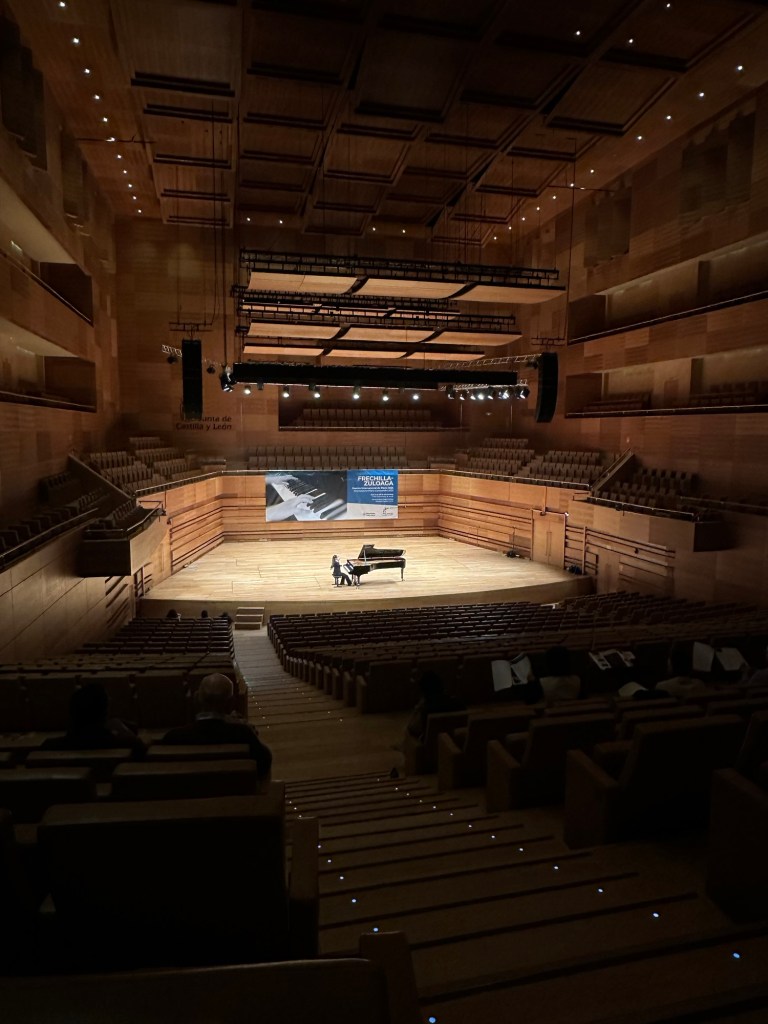
A standard, high level piano competition normally consists of three rounds: the first round would be a short one during which the contestant demonstrates his or her technical ability with etudes. Competitions also often call for a prelude and fugue by Bach or a short Scarlatti sonata. These are deceptively demanding because despite their brevity, the Baroque counterpoint requires intensive focus and the music is highly exposing; it is very easy to spot when a pianist has taken a wrong turn or lost concentration. Sometimes a movement from a classical sonata is also asked for to assess a pianist’s comfort in diverse styles.
The second round is usually longer–45 minutes to an hour–and allows more freedom and flexibility with repertoire choice. This is often where pianists have a chance to showcase their skill at handling large-scale Romantic or post-Romantic works. Contestants will often include at least one virtuosic work to demonstrate their capabilities as well as create a lasting impression. This round will feel more like a performance than an audition.
The third and final round will be a concerto round, where the finalists get to fulfill their dream of playing as a soloist with an orchestra. Most competitions have a concerto list, as most orchestras cannot be expected to whip up every single concerto in musical history at a moment’s notice. Oftentimes Romantic concertos are chosen as they are the most effective showstoppers (these concertos are sometimes known as “warhorses”); here, concerto choices can determine winners. It’s very rare a concerto from the classical period can beat a concerto by Brahms, Rachmaninov or Prokofiev. In fact, Rachmaninov’s Third Concerto is so effective in winning competitions that some competitions have removed it from their concerto list.
I did not stay for the entire competition, but I did sit through almost half of the first round performances, which actually revealed a lot about each pianist despite the short length of each performance. From the first performances I could tell who the finalists were, and I was correct.
The economic term ceteris paribus comes to mind. “Other things being equal”. Of course, music is extremely subjective, but the idea of having a jury panel of four or more people is that we get something closer to the median. If you have a jury member who is partial to a certain competitor, this bias will be offset by all the others who are not; if you have a jury member who is partial to a certain composer, it will be offset by all those who are not etc.
In the end, having sat through many first round performances, I did think the jury’s choices of who to put through to the second round were justified. In general, despite the divergence in their playing styles, these were pianists who demonstrated confidence, maturity and readiness.
And so here are some of the observations I made about the competition, which I believe applies to most piano competitions.
1. Do not underestimate the first round.
In fact, I believe the first round is the most challenging round. A lot of pressure is on this round. You feel the need to show your best among the most number of contestants in the competition, yet you have the shortest amount of time to show it, and the repertoire required often restricts freedom of expression. For example, too much individuality in a Bach prelude and fugue can ruin the piece; or the technical challenges of etudes mean there is less scope to be free and expressive.
In such a short space of time, having to deliver performances of technically difficult, highly exposing musical works which are very familiar to most pianists does put a lot of pressure on you.
Unlike larger-scale works included in the second “recital round”, where you can gradually “warm up” as you play, many of the short works of the first round require the pianist to hit their stride immediately. If you are unable to get “into the zone”, it becomes a very boring performance which is over before you even have time to feel warmed up.
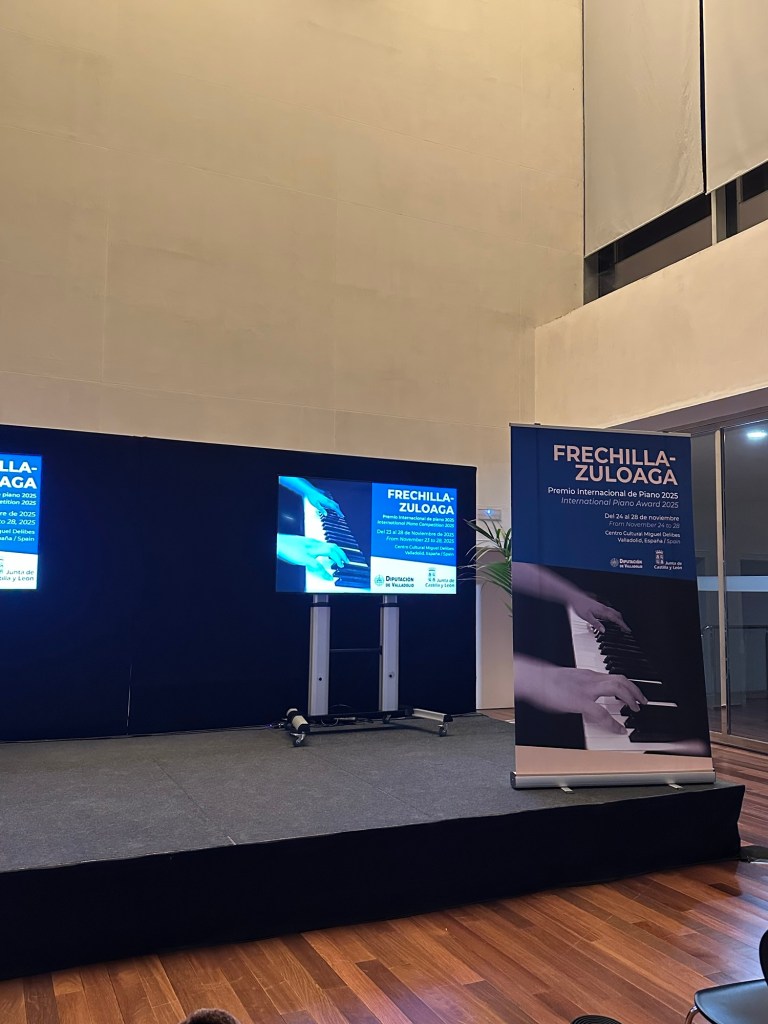
2. An impression is made from the very first note.
Sitting through first-round performances back-to-back, I quickly got a sense of how the jury feels. Luckily, 18 of us were pre-selected for the first round of the Frechilla-Zuloaga Competition; imagine having to listen to 80 pianists playing very similar things!
Very soon, one performances blurs into another. What I have found, however, is that how a person begins very much determines the rest of his or her performance. I don’t mean how flawlessly they play the first piece; there were times in the competition when a pianist played a much better Chopin etude than a Bach prelude and fugue.
No, I mean how they play the first note. The tone, their touch; one can really tell from the tone whether this is a performer who is confident in his own performance or whether this is still a student trying to get through the piece. This is especially obvious when everyone plays one after the other. Someone’s tone can make a much more lasting impression than the accuracy of their playing, although it’s often true that tone conveys confidence and confidence often comes from one’s familiarity with the piece and the competition environment.
3. How you react to the space and the piano is very important.
Talking to the jury members after the result announcement of the first round (even though it was hard to track them down, I managed to catch two of them), I gleaned from them that noticing how quickly pianists can adapt to an unfamiliar space is a very good way of distinguishing a winner from a contestant. I also felt that when watching the first round performances myself: those who were able to relax into the acoustics of the hall almost immediately were the ones whose music was most able to hold my attention; those who couldn’t, their discomfort is discernible in their performance.
Unfortunately for us, despite the glorious setting and the nicely regulated Steinway we got to play on, there wasn’t an opportunity for us to try both out before playing the first round. Yet it also meant part of the comparison lay in how quickly we could get used to both the space and the piano.
I must say, I felt the discomfort myself. I was fully settled in the Bach prelude and fugue and enjoyed it so much playing in that wonderful hall, but I struggled with the piano when playing the Scriabin. I wanted to create this big sound that I’m “known” for but some reason the sound just wasn’t powerful enough, so I tried harder. Afterwards, a jury member told me my sound was slightly harsh and I have to agree. Sometimes, having a different piano means not always having things your way. Sometimes that’s a blessing–as it was in my Bach–and sometimes it’s a curse–as it was in my Scriabin etude.
Learning to adapt is important. After all, as one jury member told me, that’s part of what being a professional concert pianist is about.
And so, practising performing on different pianos is a good way to prepare for competitions. Embracing whatever situation you are thrown into, reacting to the space and the piano you are given, and being comfortable with uncertainties is part of being good at competitions.
4. Wrong notes are not as important as you think. Take risks.
Any person who has to sit through so many first-round performances will hardly have the time to be hawking over every note a pianist plays.
It’s true; in the livestream comments of the Chopin Competition people will tear you apart if you play an F instead of an F# amidst a flurry of semiquavers, but I hardly think that is what the jury is looking out for.
What made my ears perk up after hearing many flawless performances was when a pianist, completely at ease on stage and at the keyboard, took huge risks with his playing. Not because it was his intention to, but because he was so completely free that he wanted to take the music to the limits. There was a section in the Bach fugue where this particular pianist played the countersubject with such lightness it was barely audible, but that made it so exciting as audience and performer discovered together the capabilities of sound and instrument. Incidentally, he was later awarded First Prize at the Finals.
Had he dropped a few notes along the way, I probably wouldn’t have noticed, nor–if I had–would I care. The best performer is the one who can bring his audience, even the one who possesses the most trained ear, away from the score toward the music.
5. Confidence is key.
Clichéd as this may sound, I believe this mantra has a significant impact on one’s playing. Ultimately, playing in a competition is still a performance. If one is not confident in what one has to say, the message will never come across; the same with piano performance. Just because you can play, it does not mean you can perform.
In such a high level competition as the Frechilla-Zuloaga Competition, where everyone can play, the only thing that distinguishes between them is the ability to really communicate with confidence.
Of course, in something as naked as piano playing, confidence cannot be faked the same way it could be for a corporate job interview or a Silicon Valley pitch. You will not feel confident about performing if you are inexperienced or unfamiliar with your pieces, and that’s why you must always BE PREPARED.
But after all the preparation, you must throw away all the insecurities that come with preparing something for such a long time, and perform as if this is the easiest thing in your life, even when it isn’t. This is where “faking it” comes into play.
There were pianists whose playing wasn’t so clean but whose tone was so confident and convincing that, even if I could spot the mistakes, I would’ve brushed them off and thought “eh, he’s probably just not on top form, but I’ll give him another chance because he seems to know what he’s doing” and oftentimes these pianists do not disappoint; they deliver on their promise.
6. Aim to win, not to do your best.
This is perhaps more to do with the mentality around competition preparation rather than the competition itself, and I got it off this YouTube video by Denis Zhdanov, a seasoned winner of piano competitions who does great content, but I think of it more like “shoot for the moon in order to land among the stars”.
There were many times I arrived at competitions having barely learned the pieces, or even if I had prepared them thoroughly I would simply tell myself trying my best is good enough. The problem is, with that mentality you will always hope people choose you, cross your fingers that all will go well. That affects your mental state in preparing for a competition. Perhaps you will not try to make your performance as airtight as possible, or you will be easy on yourself with practice.
It’s not about being arrogant; it’s about being in control. Being confident that you have an uncertain situation under control, and that you are here to showcase yourself rather than hope they pick you. And that’s how this mentality can help not only your preparation stage but also your performance stage.
7. Not passing is not failure, but you can always improve on yourself.
There are thousands of piano competitions out there. You cannot imagine the amount of times I’ve seen a good pianist get rejected in the first round of a competition just to win another one a week later, and sometimes an even bigger competition!
Despite what I’ve said about how one can distinguish great pianists ready for a career from students who can play extremely well at high-level competitions, there are many factors that come into play at different competitions. After all, music is a very subjective matter, jury members are also human beings with different tastes and biases, and even a great pianist can have his or her occasional off-days.
Many factors could have led to you not getting what you want at competitions, the possibilities are endless, but if you were to give up because of factors you cannot control, then that would be on you.
Your belief in your own playing should not be based merely on external opinion; true artistry stems from belief of one’s own artistic impulses and the courage to stick to them.
That being said, there are of course things you can work on. This is why I was intent on observing other performances, reflecting on my own, and asking for the jury’s feedback this time round even if it can feel humiliating to have only played for a few minutes and then basically be asked to leave. I know there are things I can improve on and competitions are a good way of identifying them.
I like to think that everyone I meet at competitions are on the same journey of self-improvement. Some have been on it for longer than others, but if you persist for long enough, and view it with the right mindset, something good is bound to come out of it.
 Literally Left-handed
Leave a reply to Lessons from a piano competition part 1: preparation – Literally Left-handed Cancel reply